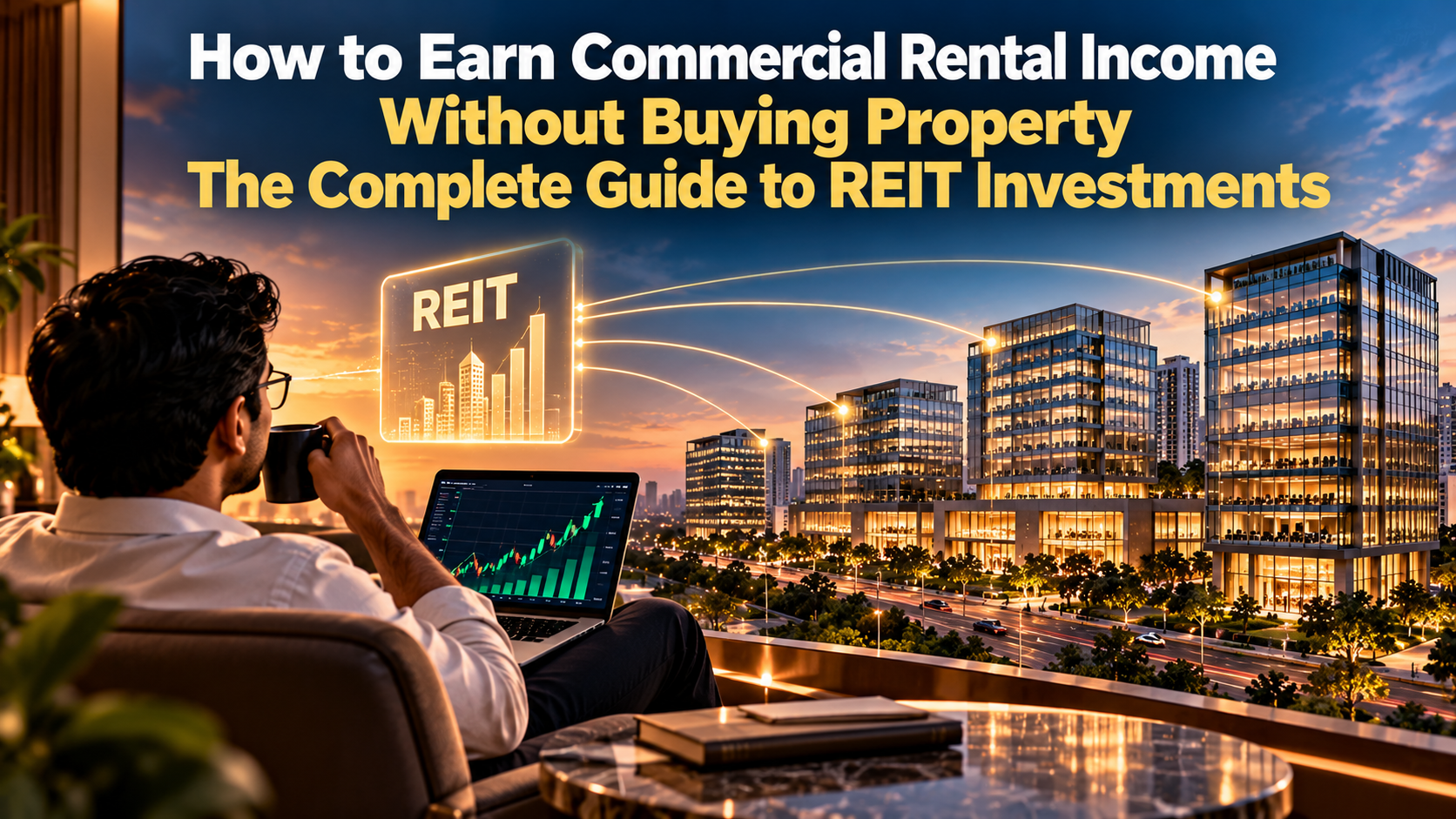
For generations, purchasing physical real estate has been deeply ingrained in the Indian psyche as the ultimate symbol of financial security and wealth preservation. A residential apartment that appreciates steadily over the decades or a commercial shop that generates a consistent monthly rent check has long been considered the bedrock of a robust household portfolio. Yet, the modern financial landscape is evolving rapidly.
While the appeal of tangible property remains strong, the barriers to entry for direct ownership have skyrocketed. Premium commercial real estate—the kind that yields the highest rental returns—now requires a staggering upfront capital commitment that is entirely out of reach for the average retail investor. Furthermore, the ongoing responsibilities of property maintenance, tenant management, and navigating legal paperwork often turn a passive income dream into a full-time administrative headache.
Fortunately, the financial markets have introduced a highly efficient alternative. For those looking to participate in the lucrative world of real estate without the burden of buying and managing physical units, Real Estate Investment Trusts have emerged as a game-changing asset class. Listed on major stock exchanges, these trusts offer a streamlined route into income-generating commercial real estate, completely removing the responsibilities of direct ownership.
Understanding how this modern investment proposition translates into actual returns, however, requires looking beyond the glossy appeal of passive income. It demands a thorough evaluation of how these trusts operate, how they distribute cash, and the precise market dynamics that dictate their long-term performance.
The Traditional Hurdles of Direct Property Ownership
To fully appreciate the value proposition of a listed trust, one must first confront the harsh realities of buying commercial real estate directly. Acquiring a premium office space or a high-footfall retail unit in a major metropolitan hub like Mumbai, Bengaluru, or Delhi NCR involves raising immense capital. Most investors are forced to take on heavy debt, committing themselves to high-interest mortgage payments for a decade or more.
Beyond the initial purchase price, direct ownership is fraught with hidden, ongoing expenses. There are exorbitant stamp duty charges, registration fees, property taxes, and continuous maintenance costs. When the property is finally ready to let, the owner assumes the arduous task of finding reliable corporate tenants, negotiating complex lease agreements, and handling the inevitable operational disputes.
Perhaps the most significant risk of direct ownership is the lack of liquidity and the threat of prolonged vacancy. If a tenant vacates a standalone commercial property, the rental income drops to zero instantly, while the mortgage payments and maintenance costs continue unabated. Furthermore, if the owner urgently needs to liquidate the asset to free up cash, selling a physical property can take several months, if not years, with the final sale price heavily dependent on localized market conditions and painful price negotiations.
Decoding the Real Estate Investment Trust
A Real Estate Investment Trust completely flips this traditional model on its head. Instead of an individual purchasing a single office space or retail unit, a trust pools capital from thousands of investors to acquire, manage, and scale a massive, diversified portfolio of income-generating real estate assets.
These portfolios typically consist of Grade A commercial office parks, sprawling retail malls, massive logistics warehouses, and sometimes specialized healthcare facilities or data centres. These assets are managed by a dedicated team of real estate professionals whose sole job is to optimize occupancy, negotiate lucrative long-term leases with top-tier corporate tenants, and maintain the structural integrity of the buildings.
The trust is then divided into units, which are listed and traded on major stock exchanges just like regular equity shares. By purchasing these units, an everyday investor instantly gains fractional exposure to a multi-billion dollar commercial real estate portfolio. The investment becomes completely liquid—units can be bought or sold at the click of a button during standard market hours, entirely eliminating the liquidity trap associated with physical property.
The core proposition is incredibly straightforward: investors get to participate in the robust economic activity generated by premium commercial real estate, completely bypassing the heavy lifting of being a direct landlord.
The Mechanics of Income Generation and SEBI Mandates
The primary allure of this asset class is the promise of regular income, but how exactly does a portfolio of buildings translate into cash deposited into a brokerage account?
The underlying properties within the trust generate revenue primarily by leasing space to multinational corporations, domestic businesses, and retail brands. Every month, these tenants pay rent based on strictly negotiated, long-term lease agreements. However, the gross rent collected from these properties does not automatically equal the amount distributed to unitholders.
The trust must first cover its operational expenses, which include property management fees, routine maintenance, insurance, and the interest obligations on any debt used to finance the real estate acquisitions. The trust must also set aside capital for future building upgrades. What remains after these crucial deductions is known as the net distributable cash flow.
In India, the Securities and Exchange Board of India has created a highly protective, investor-friendly regulatory framework governing these trusts. Under the current SEBI regulations, a listed real estate trust is legally mandated to distribute a minimum of 90 percent of its net distributable cash flows back to its unitholders on a semi-annual basis.
This strict 90 percent distribution rule is the defining feature of the structure, ensuring that the bulk of the rental income flows directly back to the investors rather than being hoarded by the management. However, investors must recognize that this regulatory mandate is not a guarantee of a fixed income. If the underlying properties face high vacancies, if rental rates drop due to a market recession, or if the trust’s borrowing costs suddenly spike, the net cash available for distribution will inevitably shrink.
Unpacking the True Nature of Distributions
When an investor receives a periodic distribution from their trust, it is crucial to understand that this payment is fundamentally different from a direct rent check. When you own a property directly, the rent is a straightforward transaction between you and the tenant. In a trust structure, the distribution is a complex payout that reflects the aggregate financial performance of dozens of properties and the holding company’s corporate structure.
These distributions are typically broken down into three distinct components: dividend income, interest income, and the repayment of capital. The exact composition of these payouts varies significantly from trust to trust and quarter to quarter, depending on how the holding company has structured its internal debt and equity with its underlying special purpose vehicles.
This composition has massive implications for the investor’s post-tax returns. Depending on the specific structure of the trust and the investor’s personal income tax bracket, the dividend portion might be entirely tax-free in the hands of the unitholder, while the interest component is usually taxed at the applicable marginal rate. The repayment of capital reduces the investor’s acquisition cost, which eventually impacts capital gains calculations when the units are eventually sold.
Because of this complexity, smart investors do not merely look at the headline distribution yield. They review the detailed quarterly disclosures, understand exactly what percentage of their payout is taxable, and frequently consult with professional tax advisors to map out their true net returns.
Key Metrics for Evaluating a Commercial Portfolio
Not all commercial portfolios are created equal. Since the performance of the trust is inextricably linked to the quality and productivity of its underlying physical assets, prospective investors must evaluate the portfolio with the same rigorous scrutiny they would apply to buying a house.
Occupancy levels are the most immediate indicator of portfolio health. A trust that consistently maintains occupancy rates above 90 or 95 percent across various market cycles clearly owns highly desirable assets and possesses a strong leasing team. However, high occupancy must be paired with an analysis of the lease expiry profile, often referred to as the Weighted Average Lease Expiry (WALE).
If a large percentage of the portfolio’s leases are scheduled to expire within the next twelve months, the trust is highly exposed to immediate market volatility. If the broader commercial market is in a slump, those expiring leases might have to be renewed at significantly lower rental rates, directly impacting future distributions. Conversely, a long lease expiry profile—where corporate tenants are locked in for the next five to seven years with built-in annual rent escalations—provides massive income stability and predictable cash flow growth.
Location and tenant diversification are equally vital. A portfolio heavily concentrated in a single city or overly reliant on one specific industry—such as the IT sector—carries massive concentration risk. A well-managed trust deliberately diversifies its assets across multiple high-growth metropolitan areas and leases space to a broad mix of technology, financial services, healthcare, and consulting firms, effectively insulating the portfolio from localized economic shocks.
Navigating the Inherent Market Risks
While the appeal of professionally managed, rental-backed cash flows is undeniable, these investments carry distinct macroeconomic and operational risks that should never be overlooked.
The most prominent external risk is interest rate sensitivity. Because commercial real estate is a highly capital-intensive business, trusts frequently utilize debt to acquire new properties and expand their portfolios. When central banks aggressively raise interest rates to combat inflation, the trust’s borrowing and refinancing costs surge, which can directly compress the net cash available for distribution. Furthermore, in a high-interest-rate environment, traditional fixed-income instruments like government bonds become more attractive, often leading investors to sell out of real estate trusts, which drives down the market price of the listed units.
Valuation volatility is another critical factor. Unlike a physical property where the price only changes when you decide to sell, listed units are marked-to-market every single trading day. This means the unit price will constantly fluctuate based on broader stock market sentiment, earnings expectations, and global economic news, entirely independent of how well the underlying buildings are actually performing.
Investors must also be highly conscious of the trust’s leverage. While strategic borrowing can enhance returns, excessive debt creates dangerous repayment obligations. A thorough review of the trust’s loan-to-value ratio and its upcoming debt maturity schedule is absolutely essential before committing capital.
Direct Real Estate vs. Listed Trusts: Choosing Your Path
The decision between purchasing direct physical real estate and investing in a listed commercial trust ultimately boils down to an investor’s personal financial objectives, available capital, and desired level of active involvement.
Direct ownership remains highly attractive for individuals who possess substantial upfront capital, desire absolute operational control over their asset, and are comfortable managing the friction of tenant relations and property maintenance. It is a tangible, hands-on investment that allows owners to physically modify the asset to force appreciation over time.
Listed trusts, on the other hand, are tailor-made for investors seeking genuine passive income. They offer immediate exposure to institutional-grade commercial property—assets that are entirely inaccessible to the retail market—with the added benefits of professional management, strict regulatory oversight, and total liquidity. There are no midnight calls about broken air conditioning units or agonizing months spent searching for a reliable tenant.
However, this convenience means sacrificing control. As a unitholder, you cannot decide which buildings the trust acquires, which tenants they approve, or when they choose to sell an asset. You are entirely reliant on the expertise and integrity of the management team.
The Final Verdict
The introduction of listed real estate trusts has fundamentally democratized access to the lucrative world of commercial property in India. By legally binding management to distribute the vast majority of their rental cash flows, SEBI has created a highly transparent, income-generating vehicle that perfectly bridges the gap between the stability of real estate and the liquidity of the stock market.
For the modern investor, the appeal of earning rental income without ever having to act as a landlord is a massive leap forward in wealth management. However, successfully navigating this space requires a disciplined approach. By looking past the headline yields, rigorously analyzing the underlying property portfolio, understanding the complex tax implications of the distributions, and maintaining a clear-eyed view of the macroeconomic risks, investors can strategically leverage these trusts to build a resilient, cash-flowing financial future.