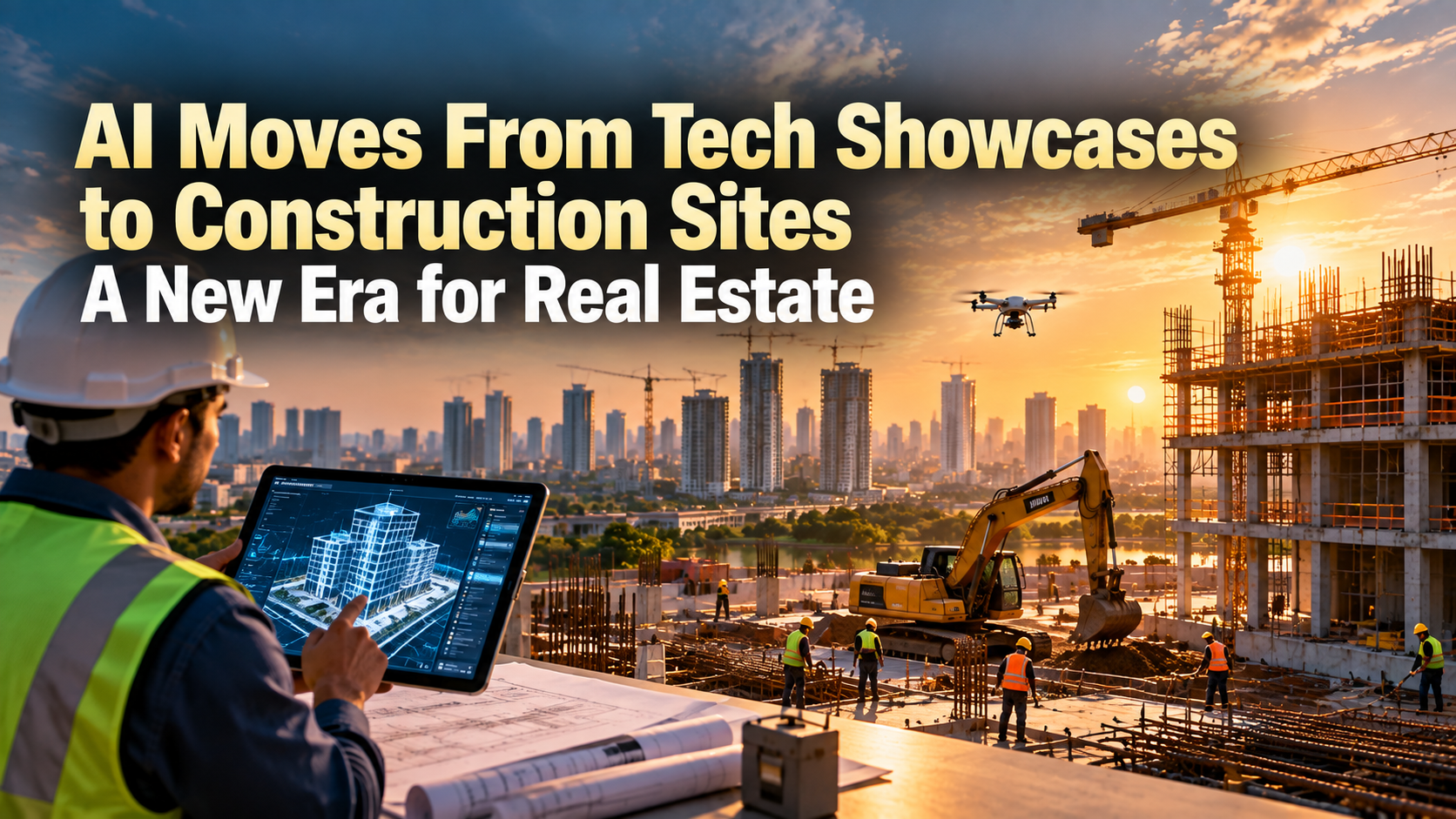
The Indian real estate sector stands on the precipice of a monumental technological shift. For years, artificial intelligence has been the buzzword dominating corporate boardrooms, predominantly serving as a shiny new tool for digital marketing, customer relationship management, and architectural visualizations. However, a profound evolution is currently underway. Artificial intelligence is moving aggressively beyond the confines of tech showcases and marketing brochures, making its way directly onto active real estate construction sites. This paradigm shift was a central theme among leading developers, property technology innovators, and industry experts at the recently concluded CREDAI NATCON 2026. The consensus across the board is clear: the future of real estate construction will be driven not just by concrete, steel, and manual labor, but by data streams, machine learning algorithms, and automated intelligence.
The Real Estate Landscape Reimagined
Historically, the construction industry has been notoriously slow to adopt cutting-edge digital technologies, often relying heavily on legacy systems and traditional manual workflows. This conventional approach has frequently led to severe project delays, massive cost overruns, and unnecessary material wastage. The narrative is changing rapidly as developers face the immense pressure of a rapidly urbanizing nation. With consumer expectations rising for faster project delivery, superior structural quality, and highly sustainable practices, technology is no longer viewed as an optional luxury upgrade; it has become an absolute operational necessity.
The integration of artificial intelligence in construction represents a fundamental reimagining of the real estate landscape. The objective is not about replacing human effort with autonomous machines, but rather augmenting human capabilities to achieve unprecedented levels of efficiency, safety, and precision. From the initial design and excavation phases to the final execution and ongoing facility management, intelligent systems are being woven into the very fabric of the property development process. This deep integration is scaling from a conceptual idea to a tangible impact, fundamentally reshaping how smart cities and premium townships will be built and managed in the coming decades.
AI Beyond the Marketing Brochure
Until very recently, the most visible applications of artificial intelligence in real estate were largely consumer-facing. Property developers actively utilized intelligent chatbots for lead generation, predictive algorithms for highly targeted digital advertising, and sophisticated rendering engines to create immersive virtual reality tours of unbuilt properties. While these digital tools successfully revolutionized property marketing and sales, they barely scratched the surface of what the technology could actually achieve on the ground.
Today, the industry focus has shifted entirely to the production side of real estate. The primary question driving innovation is no longer just how technology can help sell a property better, but how it can actually build a property better. Can artificial intelligence help developers construct massive high-rise buildings faster? Can it detect micro-structural mistakes before they become deeply embedded in the construction? Can it significantly reduce environmental waste and operate completed buildings more intelligently? The real estate ecosystem is answering these questions with a resounding yes. By deploying smart algorithms directly onto the dusty, chaotic environment of a construction site, developers are transforming a previously unquantifiable physical space into a highly measurable, data-driven ecosystem.
Continuous Monitoring and Digital Precision on Site
One of the most revolutionary applications currently reshaping the industry is the role of artificial intelligence as a continuous construction-monitoring tool. Traditionally, project management teams have spent countless hours checking whether the physical work on the ground aligns perfectly with the architectural blueprints. These manual site inspections are often periodic, inherently prone to human error, and frequently fail to capture minute structural deviations that can snowball into massive engineering issues over time.
Intelligent monitoring systems are flipping this archaic operational model on its head. A modern construction site is rapidly evolving into a digitally connected environment that generates its own continuous stream of operational data. High-definition site cameras, agile drones, and 3D laser scanners capture the physical geometry and progress of the site in real-time. This massive volume of visual and spatial data is then fed directly into advanced computer vision algorithms that meticulously compare the actual on-site conditions against the expected progress outlined in the digital building models.
This means that instead of a site engineer manually walking through thousands of square feet of scaffolding to spot a missing component or a misaligned pillar, the intelligent system automatically flags the deviation the exact moment it occurs. The entire construction site becomes continuously measurable, granting project management and engineering teams an unprecedented, macroscopic field of vision. This supreme level of digital precision ensures that quality control checks are not just a monthly afterthought, but an integral, ongoing part of the daily construction workflow.
Detecting Deviations Before They Become Expensive
In the high-stakes, capital-intensive world of real estate development, a mistake caught late is a mistake that costs millions of rupees. A slightly misaligned foundation, an incorrectly installed deep plumbing system, or a structural element that deviates even an inch from the approved safety specifications can lead to severe financial penalties, complicated legal hurdles, and massive project delays. This is exactly where the predictive capabilities of modern construction technology become invaluable.
By constantly analyzing the incoming stream of raw data from the construction site, intelligent systems can detect structural deviations with remarkable speed and surgical accuracy. If a concrete pour does not match the exact volumetric dimensions of the 3D digital model, or if a specific load-bearing component is placed incorrectly, the system instantly sends an alert to the engineering team’s dashboard. Catching these discrepancies in their absolute infancy allows for immediate, low-cost course correction. The ability to detect physical deviations before they become expensive structural failures is perhaps the most compelling return on investment for developers adopting PropTech solutions. It aggressively mitigates financial risk, ensures strict compliance with stringent government building codes, and keeps the project strictly within its allocated financial parameters.
How AI Integrates with Existing Construction Technology
The true disruptive power of this technological leap lies in its ability to integrate seamlessly with existing construction technologies. Artificial intelligence does not operate in a vacuum; it acts as the analytical brain sitting atop a vast network of interconnected digital systems. The foundation of this digital ecosystem is Building Information Modeling, a highly detailed digital representation of the physical and functional characteristics of a facility.
When intelligent machine learning algorithms are combined with Building Information Modeling, the results are deeply transformative. The digital model acts as the ultimate source of truth, detailing exactly how the building should be constructed down to the last millimeter. Meanwhile, Internet of Things sensors placed across the physical site monitor heavy equipment performance, track material inventory levels, and assess environmental conditions. Drones provide regular aerial topographic mapping, ensuring that the broader site logistics and supply chains are functioning smoothly without bottlenecks.
Artificial intelligence actively cross-references the digital blueprint with the physical reality captured by drones and sensors, creating a dynamic, real-time feedback loop. If an excavator is consuming an abnormal amount of fuel, or if a specific grade of steel is running critically low, the system predicts the impending delay and automatically suggests operational adjustments to the procurement team. This deep technological integration transforms property construction from a fragmented series of isolated manual tasks into a cohesive, highly orchestrated, and deeply predictable operation.
Safety, Efficiency, and Human Expertise
While the rapid influx of automation and intelligent systems on construction sites is undeniably game-changing, it is crucial for the industry to recognize the inherent limitations of technology. Buildings are not software programs that can be easily debugged. A major construction project operates within incredibly strict physical constraints, complex workplace safety requirements, binding legal contracts, and the unpredictable nature of human behavior. Because of these complex physical factors, the role of the human engineer and the skilled construction worker remains absolutely central to the process.
Artificial intelligence will never entirely replace human real estate judgment. A machine learning model might recommend a specific course of action based on historical data analysis, but it is the experienced, on-site engineer who must evaluate that algorithmic recommendation against the practical, often messy realities of the physical site. The technology is fundamentally designed to empower the workforce, not to eliminate it. By taking over the tedious, repetitive, and often highly dangerous tasks of manual monitoring and raw data processing, intelligent systems free up human experts to focus entirely on complex problem-solving, strategic project planning, and critical engineering decisions.
Furthermore, these technological advancements significantly enhance overall site safety. Construction sites are inherently hazardous environments where accidents can have fatal consequences. By utilizing robotic monitoring systems and agile drones for structural inspections in hard-to-reach or physically dangerous areas, developers drastically reduce the physical risk to their human workers. The seamless fusion of machine efficiency and human expertise creates a much safer, significantly more productive work environment where both the technology and the labor force operate at their absolute highest potential.
Scaling Innovations from Idea to Impact
The critical transition from conceptual technology to practical, large-scale on-site application requires a deeply strategic approach. It is one thing to successfully demonstrate a smart tracking algorithm in a controlled tech showcase; it is an entirely different challenge to deploy it successfully in the dust, noise, and chaos of an active Indian construction zone. Scaling these innovations from a mere digital idea to a measurable physical impact requires immense collaboration across the entire property technology sector.
Forward-thinking real estate firms are increasingly partnering directly with specialized construction-tech startups and establishing dedicated internal innovation hubs. These strategic collaborations focus heavily on developing bespoke technological solutions that address the highly unique challenges of the domestic construction market, such as variable labor skill levels, fragmented supply chains, and highly diverse regional regulatory environments. By investing aggressively in tailored technological solutions, leading developers are ensuring that the deployment of advanced smart systems actually translates into tangible, bottom-line benefits, including faster project completion times, enhanced structural integrity, and perfectly optimized resource allocation.
The Smart Building Ecosystem and the End-User Experience
The profound impact of artificial intelligence in real estate extends far beyond the active construction phase. Once a building is completed, polished, and handed over to the buyers, the embedded technology transitions seamlessly into predictive facility management, giving rise to the modern smart building ecosystem. Premium modern developments are no longer just static structures made of brick and mortar; they are living, breathing entities equipped with intelligent digital nervous systems.
Smart buildings utilize a massive network of sensors and continuous data analytics to relentlessly optimize energy consumption, monitor indoor air quality, and accurately predict maintenance requirements long before a critical system actually breaks down. For instance, an intelligent centralized HVAC system can constantly analyze building occupancy patterns and external weather forecasts to adjust internal temperatures dynamically, drastically reducing monthly energy costs while maximizing resident comfort. Elevators equipped with predictive maintenance algorithms can automatically alert service technicians to potential mechanical friction issues weeks before a breakdown traps a resident.
This continuous background optimization directly and profoundly enhances the end-user experience. Today’s modern homebuyers and corporate commercial tenants expect much more than just physical square footage; they actively demand living and working environments that actively contribute to their physical well-being, daily productivity, and broad sustainability goals. By embedding digital intelligence into the very core of the building’s physical infrastructure, progressive developers are delivering a vastly superior quality of everyday living, which in turn drives massive long-term asset value and brand loyalty.
Preparing for a Rapidly Urbanizing Future
As the country marches steadily towards a future defined by rapid urbanization and massive infrastructure expansion, the real estate sector faces a monumental, historically unprecedented task. Millions of citizens are migrating to urban centers every single year, demanding millions of new housing units, vast commercial spaces, and upgraded civic infrastructure at a scale never seen before. Meeting this explosive demand using slow, traditional construction methods is practically and financially impossible.
The aggressive pivot towards technology-driven construction is the only viable path forward to prevent a massive housing deficit. The critical insights shared by top developers and tech leaders clearly indicate that the adoption of intelligent construction systems is no longer a futuristic luxury reserved for experimental projects, but a present-day baseline necessity. The property industry must continue to embrace digital innovation, invest heavily in the technical upskilling of its traditional workforce, and foster a permanent culture of technological integration.
The narrative of real estate development is currently being rewritten from the ground up. By enabling continuous digital monitoring, predicting costly physical deviations, enhancing critical site safety, and creating highly optimized smart buildings, technology is fundamentally elevating the entire real estate value chain. The visionary developers who successfully harness the raw power of this technological revolution will not only build properties faster and significantly smarter, but they will also set the undisputed gold standard for the future of urban living. The architectural blueprint for tomorrow’s real estate has already been drawn, and it is entirely digital, highly intelligent, and deeply transformative.