Seven years after India’s first Real Estate Investment Trust listed on domestic stock exchanges, the country’s public real estate market has grown into a serious institutional asset class. Between 2022 and 2026, the sector expanded from just three listed vehicles with a combined market capitalisation of roughly Rs 60,000 to Rs 65,000 crore to seven platforms commanding a combined market capitalisation exceeding Rs 2.1 lakh crore. Across these listed trusts, operational holdings have crossed 195 million square feet, backed by an upcoming development pipeline of about 37 million square feet. In the second quarter of FY27 alone, India’s listed REITs collectively distributed over Rs 3,234 crore to more than 5.25 lakh unitholders.
Yet for all that growth, anyone glancing inside the portfolios of India’s publicly traded real estate vehicles will notice a heavy tilt toward a single property type. The vast majority of underlying assets remain large commercial office campuses clustered across Bengaluru, Hyderabad, Mumbai, and the National Capital Region. Of the seven listed platforms with underlying real estate assets, five are office-focused REITs, one is a retail-focused REIT, and one is an industrial and warehousing Infrastructure Investment Trust (InvIT).
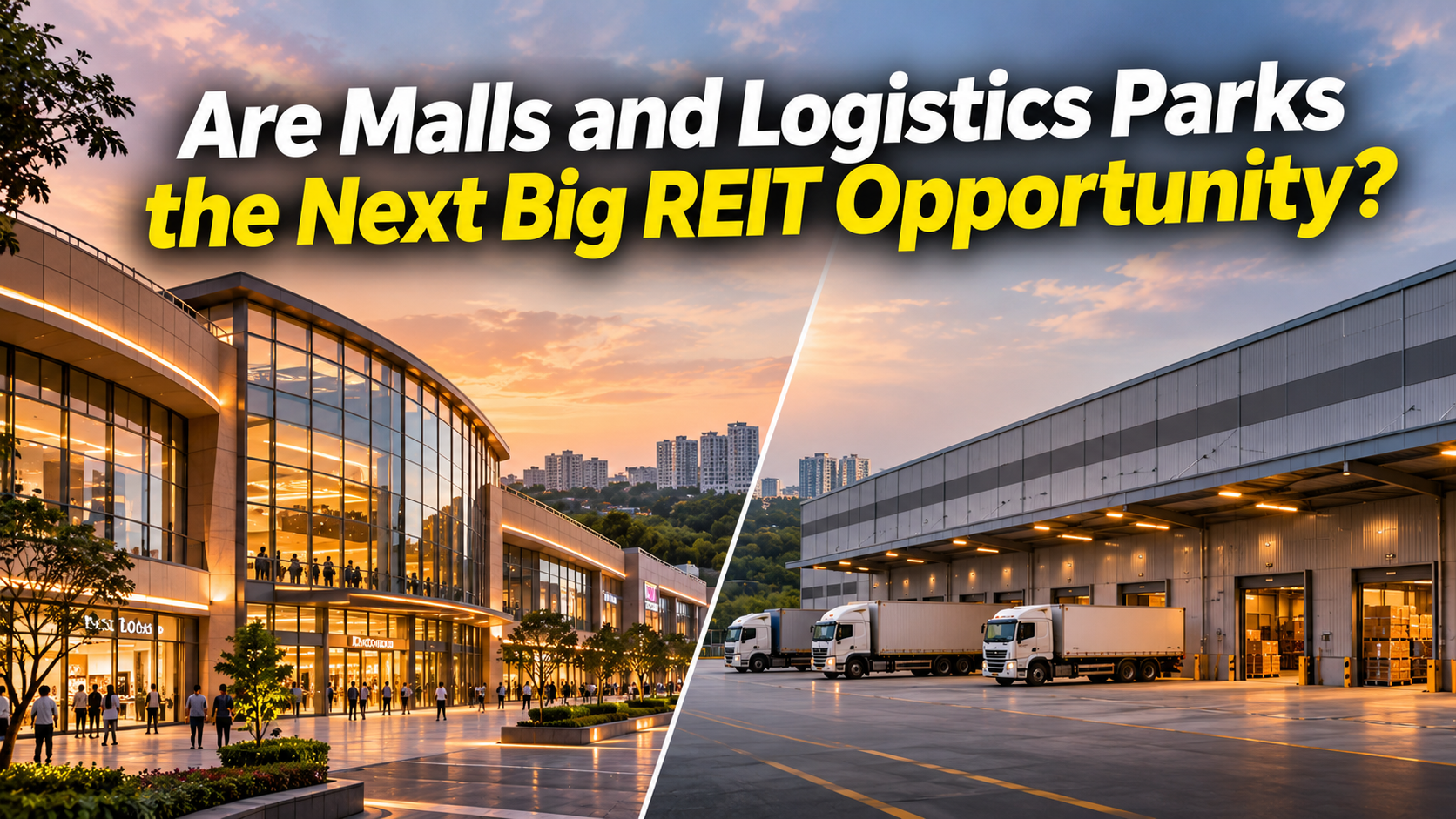
That balance is starting to shift. Strong consumer spending in organised shopping centres, rapid formalisation of India’s supply chains, and supportive regulatory changes are putting retail malls and Grade A warehouses squarely in the spotlight. Whether these two segments can grow into public-market pillars on par with commercial offices depends on their leasing fundamentals, income mechanics, and how quickly the market can overcome legacy ownership hurdles.
Why Office Towers Still Anchor India’s Listed REIT Ecosystem
Before looking at what comes next, it helps to understand why commercial offices continue to dominate India’s REIT market. Today, office properties account for roughly 84 percent of the operational area across listed real estate trusts, totaling around 164 million square feet. Even at that scale, listed trusts represent only about 19 percent penetration of India’s Tier-I Grade A office stock.
The runway for office REITs remains long. Nearly 370 million square feet of existing Indian office inventory is already assessed as eligible for future trust inclusion, and industry projections suggest office REIT penetration could climb to 30 percent by 2030. Demand from Global Capability Centres (GCCs) and multinational enterprises continues to keep occupancy healthy across premier business parks, giving office trusts predictable multi-year leases and deep institutional liquidity.
However, office portfolios carry one glaring vulnerability: geographic concentration. Bengaluru alone accounts for 42 percent of India’s listed office REIT area, while Hyderabad, Mumbai, and Delhi-NCR each represent roughly 12 to 15 percent. Because office cash flows are tightly tied to corporate hiring and global technology cycles in a handful of metro business districts, institutional and retail investors alike are actively looking for alternative real estate assets that respond to different economic engines.
Retail Mall REITs: How Organised Shopping Centres Are Finding Their Footing
Physical retail spent the early 2020s fighting off predictions that e-commerce and quick-commerce apps would empty out shopping centres. Recent leasing numbers tell a very different story. While poorly managed neighbourhood complexes have struggled, large-format, organised malls in strong urban catchments have shown steady resilience.
Across India’s top cities, retail space absorption reached approximately 8.9 million square feet during calendar year 2025, with momentum accelerating sharply in the second half of the year when roughly 5.6 million square feet was leased between July and December. That pace carried straight into 2026, with gross retail leasing across seven major cities touching 9.36 million square feet between January and September, marking a four-year high despite tighter new mall completions.
Fresh investment-grade supply also bounced back in 2025, with total retail completions reaching around 4.3 million square feet, a 268 percent year-on-year jump over 2024. Roughly 2.1 million square feet of institutional-grade mall space opened in the second half of 2025 alone, highlighted by major additions such as Lake Shore Mall Y Junction in Hyderabad at about 1.6 million square feet and UnityOne Elegante in Delhi-NCR at around 0.5 million square feet.
Demand has been led by select urban corridors, with Hyderabad accounting for 34 percent of second-half 2025 retail leasing volume, followed by Delhi-NCR at 20 percent and Chennai at 16 percent. Looking at who is actually signing these leases explains why modern malls remain relevant:
- Fashion and apparel anchors: Apparel and lifestyle retailers drove roughly 48 percent of retail leasing volume, anchoring footfall across major malls.
- Dining and experiential leisure: Food and beverage operators made up about 13 percent of space absorption, while entertainment formats such as bowling alleys, arcades, and family entertainment centres accounted for 8 percent in late 2025 and expanded further into 2026 as malls repositioned themselves as social destinations rather than simple shopping hubs.
- Offline expansion by digital brands: Direct-to-consumer (D2C) labels have steadily opened physical flagship stores alongside traditional retail chains, supported by moderating inflation, income tax adjustments, and GST rationalisation.
At present, Nexus Select Trust stands as India’s only listed retail REIT, holding a portfolio of urban consumption centres across 15 cities. Its performance has proved that public-market investors have an appetite for retail real estate, provided the malls are dominant in their catchments and run with sharp operational discipline.
Industrial and Warehousing REITs: Institutional Scale Meets Supply-Chain Growth
If retail malls track urban consumption, industrial and warehousing real estate tracks the physical backbone of India’s economy: domestic manufacturing, freight infrastructure, and organised supply chains. Over the past few years, the sector has shifted decisively away from dusty, unorganised godowns toward modern Grade A logistics parks equipped with high clear heights, heavy-duty flooring, automated dock levellers, and rooftop solar grids.
Leasing figures from the first half of 2026 underline this momentum. Across India’s eight primary industrial and warehousing markets, leasing climbed 15 percent year-on-year to 36.8 million square feet in H1 2026, up from 32.1 million square feet in the same period a year earlier. Total warehousing stock across these eight hubs expanded 14 percent year-on-year to 584.9 million square feet. Because occupier demand outpaced net new supply, overall vacancy edged down from 12.1 percent to 11.4 percent.
Even more encouraging for future warehousing REITs and InvITs is the steady upgrade in asset quality. By the first half of 2026, Grade A facilities made up 47 percent of total warehousing stock across the eight primary markets and captured 52 percent of all leasing transactions.
Occupier demand has also grown far more balanced, reducing dependence on any single industry:
- Manufacturing leads the pack: Industrial occupiers outside FMCG and consumer durables accounted for 46 percent of total leasing volume at 17.0 million square feet, up 17 percent year-on-year, driven by automotive, engineering, electronics, and energy firms expanding under domestic production incentives.
- Third-party logistics (3PL) expansion: 3PL operators represented 30 percent of total take-up at 11.1 million square feet, growing 27 percent year-on-year as companies outsource complex distribution networks.
- Retail and e-commerce realignment: Retail chains boosted warehouse take-up by 70 percent year-on-year to 2.5 million square feet (a 7 percent share), led by grocery and hypermarket formats. Meanwhile, direct e-commerce leasing dropped 44 percent year-on-year to 1.9 million square feet as online platforms consolidated fulfilment hubs and leaned more heavily on 3PL partners and compact urban dark stores for quick commerce.
At the city level, Mumbai posted its highest half-yearly warehousing leasing volume at 10.7 million square feet, up 44 percent year-on-year and representing 29 percent of national take-up. NCR followed with 5.9 million square feet (up 17 percent), Ahmedabad reached 4.1 million square feet (up 15 percent), Bengaluru hit 4.0 million square feet (up 36 percent), and Kolkata surged 69 percent to 2.4 million square feet, aided by freight upgrades such as the Western Dedicated Freight Corridor. Average Grade A rents rose 4 to 7 percent year-on-year across all eight tracked hubs, ranging from Rs 19.4 per square foot per month in Ahmedabad to Rs 28.7 per square foot per month in Pune. Looking further ahead, India’s expanding data centre ecosystem is also expected to generate tens of millions of square feet in adjacent industrial and warehousing demand by 2030.
Comparing Cash-Flow Mechanics Across Offices, Malls, and Warehouses
For investors evaluating real estate investment trusts in India, offices, malls, and warehouses are not interchangeable. Each asset class generates cash flow differently and carries its own balance of yield stability and operational risk.
- Commercial offices offer the largest scale and most standardised lease terms. Corporate and GCC tenants typically sign long-term fixed leases with built-in periodic rent escalations. Maintenance is predictable, making cash flows steady, though returns remain sensitive to white-collar hiring cycles and heavy concentration in a few Tier-I tech hubs.
- Organised retail malls combine a minimum guaranteed base rent with a revenue-share component linked directly to tenant sales. When consumer spending booms, mall REITs capture direct upside from higher retailer turnover, offering a natural hedge against inflation. The trade-off is higher sensitivity to economic slowdowns and the constant need for active tenant curation, marketing, and experiential upgrades to keep shoppers coming back.
- Industrial and warehousing parks sit on long-tenure contracts with manufacturing and 3PL tenants who often invest heavily in internal racking, automation, and conveyor systems, leading to high lease renewal rates. However, headline per-square-foot rentals are significantly lower than urban office towers, meaning warehousing trusts require large land footprints and high operational efficiency to generate comparable distribution pools.
Going Beyond Tier-I Metros: The Geographic Advantage of Non-Office Trusts
One of the most overlooked benefits of retail and warehousing trusts is where their assets actually sit. While listed office REITs remain heavily anchored in India’s biggest metropolitan business districts, non-office platforms provide direct exposure to India’s fast-growing Tier-II and Tier-III cities.
Tier-II and Tier-III markets already account for roughly 51 percent, or 5.4 million square feet, of India’s listed retail REIT portfolio, and approximately 35 percent, or 7.5 million square feet, of its listed industrial and warehousing InvIT portfolio. As expressways, multi-modal logistics parks, and rising disposable incomes reshape cities like Indore, Jaipur, Lucknow, Chandigarh, Nagpur, and Coimbatore, retail and logistics trusts allow public investors to tap into regional consumption and supply-chain growth that traditional metro-centric office REITs simply cannot reach.
Regulatory Tailwinds and the Rise of SM REITs
Policy reforms are also widening the path for non-office assets to reach public investors. Effective January 2026, SEBI reclassified REIT units as equity-related instruments for mutual fund investments, quietly unlocking a much deeper pool of domestic institutional capital for the entire sector.
At the same time, SEBI’s Small and Medium REIT (SM REIT) framework has brought fractional commercial property ownership under a regulated, exchange-listed umbrella. With a minimum investment ticket of Rs 10 lakh and a strict requirement that at least 95 percent of scheme assets be completed, revenue-generating properties, SM REITs create a viable listing route for smaller, high-yielding Grade A warehouses, urban dark-store clusters, and standalone retail assets that might not have the massive scale required for a traditional multi-thousand-crore REIT IPO.
Structural Roadblocks Holding Back Faster Expansion
Despite healthy absorption figures and clear investor interest, malls and warehouses will not overtake office REITs overnight. Three structural constraints continue to slow down how quickly new non-office trusts can be formed.
First is ownership fragmentation. Historically, a large share of Indian shopping malls were strata-sold unit by unit to individual investors rather than held under single institutional ownership. Consolidating a strata-sold mall into a clean REIT portfolio requires complex, expensive buybacks that rarely make financial sense. In warehousing, while Grade A stock has reached 47 percent nationally, legacy markets still carry substantial older inventory. Grade A penetration stands at 78 percent in Chennai and 70 percent in Pune, but drops sharply to 35 percent in Mumbai and 39 percent in NCR, limiting how much existing stock meets institutional clear-height, fire-safety, and green-building standards.
Second is localised supply and vacancy risk. In the first half of 2026, Grade A warehouse vacancy stood at 12.3 percent, higher than the 10.6 percent vacancy seen in Grade B facilities, reflecting aggressive speculative construction in the premium segment. City-level performance also remains uneven: while five major warehousing hubs posted strong growth in H1 2026, leasing volumes dipped 12 percent in Pune, 27 percent in Chennai due to tight ready Grade A supply, and 10 percent in Hyderabad where elevated vacancies lingered.
Third is operational intensity. Running a Grade A office park is largely a game of facility management and lease administration. Operating a dominant shopping mall demands continuous brand curation, event programming, and layout refreshes, while modern Grade A logistics parks increasingly require built-to-suit engineering, automation readiness, and strict environmental certifications.
The Road Ahead for Diversified Real Estate Investment Trusts in India
Commercial office towers will remain the foundation of India’s listed REIT market for the foreseeable future, backed by deep tenant demand and hundreds of millions of square feet of ready institutional stock. Still, the case for retail malls and Grade A warehouses as India’s next major REIT pillars has moved well beyond theory. Both segments offer distinct cash-flow profiles, strong exposure to Tier-II and Tier-III economic growth, and natural diversification away from metro office cycles. As single-owner mall developments mature, Grade A warehousing supply deepens, and regulated frameworks like SM REITs bring mid-sized assets to the exchanges, India’s REIT landscape is steadily evolving from a single-sector office play into a balanced, multi-asset commercial real estate market.