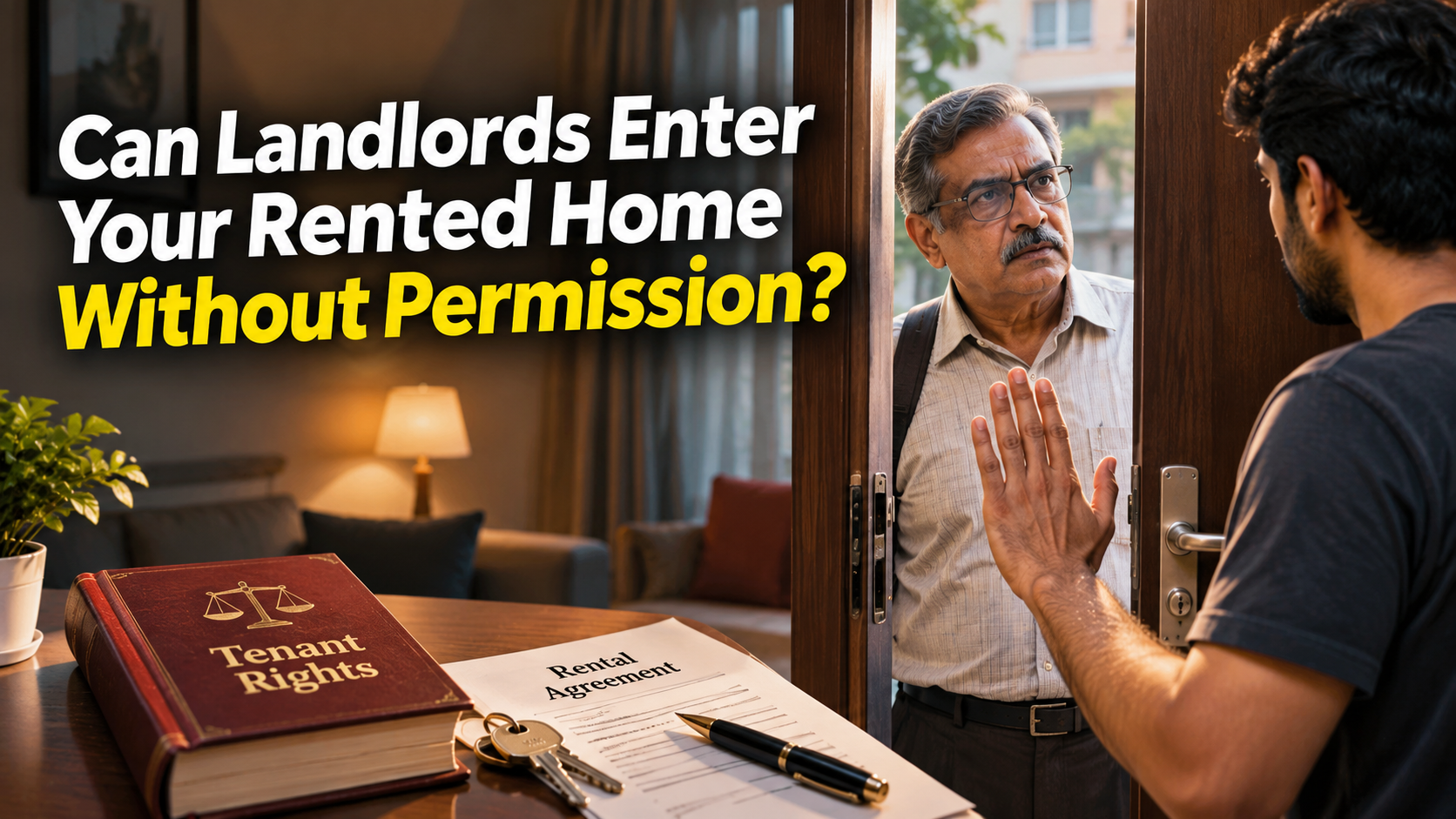
For millions of renters living across Indian cities, a quiet Sunday morning or a regular workday can quickly turn uncomfortable when a landlord shows up unannounced at the doorstep. In many cases, property owners assume that holding the title deed gives them the freedom to walk into the flat whenever they wish, inspect rooms without warning, or even use a duplicate key when the tenant is away. While this mindset is common in India’s largely informal rental market, the law views the situation very differently.
Once a valid lease or rent agreement is signed and physical possession is handed over, the rented house becomes the tenant’s lawful home for the duration of the tenancy. Ownership of the building remains with the landlord, but the legal right to occupy and enjoy the space shifts to the tenant. Understanding whether landlords can enter your rented home without permission, how spare key rules work, and where the 24-hour notice law applies is essential for every renter who wants to safeguard their privacy and avoid unnecessary friction.
Ownership Versus Lawful Possession: What Indian Law Actually Says
A common point of confusion in residential rentals is the difference between ownership and possession. Under Section 105 of the Transfer of Property Act, 1882, a lease of immovable property is legally defined as the transfer of a right to enjoy that property for a specific period in exchange for rent. The moment a landlord accepts rent and hands over the keys, they temporarily part with their right to unrestricted physical access.
This legal principle is backed by the concept of quiet possession and peaceful enjoyment. As long as a tenant pays rent on time and follows the terms of the written agreement, they are entitled to live in the property without interference, surprise inspections, or uninvited visits from the owner. A landlord still holds certain legitimate rights, such as ensuring the building is not being damaged or carrying out structural repairs, but those rights must always be exercised reasonably and with the tenant’s knowledge.
Simply put, a property owner cannot treat an occupied rental apartment as an extension of their own living room. Entering without consent undermines the very foundation of a residential lease.
The 24-Hour Notice Law Under the Model Tenancy Act, 2021
To bring uniformity and clarity to landlord-tenant relationships across the country, the Union Cabinet approved the Model Tenancy Act in June 2021 and circulated it to all states and Union Territories for adoption. One of the clearest protections built into this framework directly addresses landlord entry.
Under the Model Tenancy Act, 2021, a landlord or property manager is required to give at least 24 hours of prior written notice before entering a rented premise. Even with advance notice, entry is only permitted for reasonable and legitimate purposes. These typically include carrying out necessary structural repairs, inspecting the condition of the property, or fulfilling specific maintenance obligations outlined in the agreement.
Notice alone does not mean a landlord can arrive at odd hours. Visits are expected to take place during reasonable daytime hours, and the purpose of the visit should be clearly communicated beforehand. The only recognized exception to the 24-hour written notice rule is a genuine emergency. Situations such as a burst water pipe, a gas leak, an electrical short circuit, or a fire that threatens the safety of the building or neighboring flats allow immediate entry to prevent serious damage.
Because land and tenancy fall under the State List in India, the Model Tenancy Act does not automatically apply nationwide. Each state must enact its own legislation aligned with the model framework. States including Uttar Pradesh, Tamil Nadu, Andhra Pradesh, and Assam have already adopted tenancy laws based on these principles. In states that have not yet enacted the Model Tenancy Act, existing state rent control acts and the terms of the signed rent agreement govern landlord entry. Even in those states, courts consistently uphold a tenant’s right to privacy and reasonable prior notice.
Landlord Spare Key Rules: Can Owners Keep a Duplicate Key?
Few issues spark as much debate among urban renters as the spare key question. Many landlords insist on keeping a duplicate set of keys when handing over a flat, citing emergencies like plumbing leaks or the need to assist if a tenant gets locked out.
Strictly speaking, there is no blanket statutory ban in India that stops a landlord from retaining a spare key if both parties agree to it. The real legal boundary is not the possession of the spare key itself, but how that key is used. Retaining a duplicate key never authorizes a landlord to unlock the front door and step inside an occupied home without the tenant’s prior knowledge and explicit consent.
Using a spare key to enter a flat while the tenant is at work, out of town, or asleep is a direct violation of the tenant’s right to privacy and peaceful possession. If a landlord enters without permission and the tenant’s belongings are disturbed, or if the entry causes fear or harassment, the issue can quickly escalate from a civil contract dispute into a serious legal matter.
To avoid awkward misunderstandings, tenants and landlords should settle spare key rules before signing the agreement. Some tenants prefer to hold all sets of keys during the lease term and hand them back upon vacating. Others are comfortable leaving a sealed spare key with the landlord strictly for documented emergencies, provided that condition is written clearly into the rent agreement. If a tenant suspects that a previous renter or an uncooperative owner still holds an unauthorized copy of the key, discussing a lock change with the landlord and returning the new keys at the end of the tenancy is a practical middle ground.
When Can a Landlord Legally Enter a Rented Property?
While unannounced visits are out of bounds, tenants also need to understand the situations where a landlord does have a valid reason to request entry. Tenancy works best when both sides respect reasonable boundaries.
A landlord can lawfully enter a rented home in the following scenarios:
- Scheduled repairs and maintenance: Under standard tenancy frameworks, major structural repairs, external plumbing lines, and wiring faults generally fall under the landlord’s responsibility, while routine upkeep belongs to the tenant. When structural work is needed, the landlord can enter after providing 24 hours of written notice.
- Routine property inspections: Landlords have a legitimate interest in ensuring their asset is not being misused, altered structurally without consent, or sublet illegally. Periodic inspections are permissible if they are scheduled in advance at a mutually convenient time and are not frequent enough to amount to harassment.
- Showing the property to prospective tenants or buyers: During the notice period before a tenant vacates, a landlord may need to show the flat to incoming renters or potential buyers. Even during this transition phase, visits must be coordinated ahead of time rather than springing strangers on the current occupant without warning.
- Genuine emergencies: Immediate threats to life or property, such as severe flooding, fire, or gas leaks, justify emergency access when the tenant cannot be reached in time.
In every non-emergency scenario, communication is the deciding factor. A quick written message via email or WhatsApp at least a day in advance, followed by the tenant’s confirmation, keeps the process transparent and legally sound.
Unauthorized Entry and Criminal Trespass Under Section 329 of the BNS
When a landlord repeatedly ignores requests for notice, forces their way into a rented flat, or uses a spare key to enter with the intent to intimidate, annoy, or harass the occupant, the conduct crosses into criminal territory.
Under Section 329 of the Bharatiya Nyaya Sanhita (BNS), which replaced the older Indian Penal Code provisions on trespass, criminal trespass protects the person in lawful possession of a property, not necessarily the registered owner. This distinction is vital for renters. Because a tenant holds lawful possession during the lease term, a landlord can actually be held liable for trespass against their own tenant if they enter unlawfully with the intent to commit an offence, intimidate, insult, or annoy the occupant.
Indian law treats entry into a dwelling even more seriously than general trespass. Under Section 329(1) and 329(3) of the BNS, general criminal trespass carries a punishment of imprisonment for up to three months, a fine up to Rs 5,000, or both. However, unlawful entry into a building used as a human dwelling qualifies as house trespass under Section 329(2) and 329(4) of the BNS, which is punishable with imprisonment for up to one year, a fine up to Rs 5,000, or both.
It is worth noting that a single technical lapse, such as a landlord knocking without giving a full 24-hour notice during a polite visit, does not automatically constitute criminal trespass. Courts look closely at deliberate intent to intimidate, harass, or commit an unlawful act. Still, both criminal trespass and house trespass under Section 329 of the BNS are cognizable offences, meaning the police have the authority to register an FIR and investigate when clear harassment or unlawful forced entry occurs.
Practical Steps Tenants Should Take If a Landlord Enters Without Permission
Dealing with an intrusive landlord can feel stressful, especially when you have already paid a hefty security deposit and settled your family into the neighborhood. Responding calmly and documenting everything puts you in a much stronger position than reacting in anger.
Start by communicating your boundary clearly in writing. Send a polite but firm message via WhatsApp or email noting the date and time of the unannounced visit, reminding the landlord of your right to peaceful possession, and requesting at least 24 hours of advance notice for any future visits. Keeping communication written creates a timestamped paper trail that is far more reliable than verbal conversations.
If the unauthorized entry happens again, gather solid evidence. Save all text messages, call logs, and emails. If you have a doorstep camera or building CCTV footage showing the landlord unlocking the door in your absence or attempting to force entry, preserve those recordings immediately. Also keep copies of your signed rent agreement, rent payment receipts, and police verification records easily accessible to prove lawful possession.
When polite reminders fail, the next step is sending a formal legal notice through a property lawyer. A written legal notice citing breach of the rent agreement and interference with quiet possession is often enough to make an overbearing landlord step back. If the landlord threatens illegal eviction, cuts off essential utilities like water or electricity, or enters aggressively, you can approach the local Rent Authority in states governed by the Model Tenancy Act, or file a written complaint and FIR at the nearest police station under Section 329(4) of the BNS for house trespass. If the police hesitate to register the complaint, citizens also have the right to escalate the matter to the Superintendent of Police or approach a Judicial Magistrate.
Essential Clauses to Include in Your Rent Agreement Before Moving In
The easiest way to prevent entry disputes is to address them clearly before you hand over the security deposit. Most standard 11-month leave and license or rent agreements drafted by local brokers focus heavily on rent amount, lock-in periods, and painting charges, while leaving privacy terms vague.
Before signing your next agreement, make sure it explicitly covers a few key safeguards:
- Prior notice clause: State clearly that the landlord or their representative must provide at least 24 hours of written notice before visiting the premises for inspection or repairs, except in verified emergencies.
- Spare key policy: Document exactly how many sets of keys are handed over to the tenant at move-in, whether the landlord retains a duplicate set, and the strict condition that any spare key may only be used with prior written consent or during a documented emergency.
- Repair responsibilities: Clearly divide major structural maintenance and routine upkeep so there is no confusion over when technicians or the owner need access.
- Essential services protection: Include a clause confirming that essential utilities such as water, electricity, gas, lift access, and parking cannot be withheld or disconnected during any disagreement.
- Proper registration and documentation: Ensure the agreement is properly stamped, and registered where required by state law, alongside a signed inventory list and move-in photographs.
Renting a home is a two-way commitment built on mutual respect. Landlords deserve to know their property is being cared for and rent is paid on time, while tenants deserve the security of knowing their front door will not open without their consent. By knowing your rights under Indian tenancy laws and putting clear entry and spare key rules in writing from day one, you can enjoy your rented home with complete peace of mind.
If you still want an answer based specifically on the website you shared, you can paste the content here, and I will rewrite or update the blog based on that.