Investing in a home is often the most significant financial decision a person will make in their lifetime. For years, prospective property buyers have approached the real estate market with a mix of high hopes and deep-seated anxieties. You visit a developer’s office, walk through a beautifully designed sample flat, study the glossy brochures showcasing expansive green spaces, and review the sanctioned layout plan. Based on these promises, you commit your life savings and sign a builder-buyer agreement.
However, one of the most persistent and distressing issues in the Indian real estate sector has been the nasty surprise awaiting buyers at the time of possession. Countless homeowners have unlocked their new doors only to find that the reality of their apartment drastically differs from the promised plan. Carpet areas mysteriously shrink, promised parks are replaced by additional residential towers, and common amenities are severely compromised to make way for more saleable space. For decades, buyers had little to no legal recourse against these unilateral builder decisions.
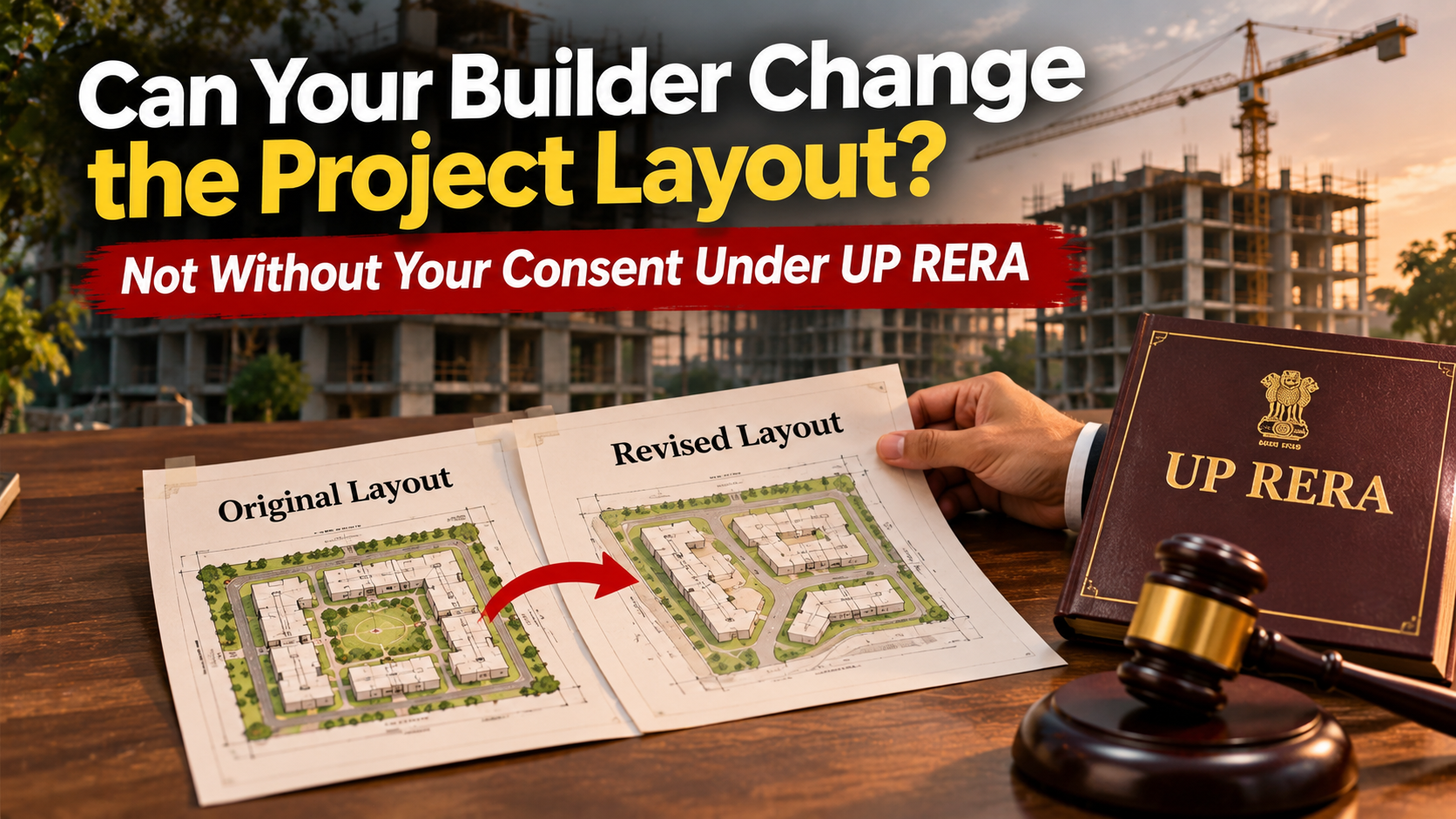
That era of unchecked developer supremacy is rapidly coming to an end in Uttar Pradesh. In a monumental move to protect consumer rights and enforce strict transparency, the Uttar Pradesh Real Estate Regulatory Authority (UP RERA) has issued a firm directive regarding building plan modifications. The authority has made it absolutely mandatory for developers to obtain informed, written consent from at least two-thirds of the allottees before they can proceed with any major changes to the sanctioned project plans.
Understanding the Power of Section 14 of the RERA Act
To fully grasp the magnitude of this new directive, it is essential to look at the legal foundation upon which it is built: Section 14 of the Real Estate (Regulation and Development) Act, 2016. When the RERA Act was passed, it was designed specifically to balance the scales between powerful real estate promoters and vulnerable homebuyers.
Section 14 of this act serves as the ultimate safeguard for a buyer’s physical asset. It legally binds the developer to execute and complete the project strictly in accordance with the sanctioned plans, layout plans, and specifications that were approved by the competent civic authorities and disclosed to the buyer at the time of booking. Once an allottee has paid their booking amount and signed an agreement based on a specific layout, the developer loses the right to alter that layout arbitrarily.
If a developer finds it necessary to make a major modification—such as altering the floor plan, changing the structural design of the building, or revising the overarching layout of the entire society—the law dictates that they cannot do so without explicit permission. UP RERA’s latest enforcement ensures that this permission must come directly from the people who have a financial stake in the project: the homebuyers. Specifically, a developer must secure the written consent of a minimum of two-thirds of the total allottees in that specific project or phase.
The Abolition of the Blanket Consent Loophole
While Section 14 has existed since the inception of RERA, some developers historically found creative legal loopholes to bypass the spirit of the law. The most common tactic was the insertion of a “blanket consent” or “general consent” clause deep within the fine print of the builder-buyer agreement.
When a buyer sat down to sign the voluminous agreement for sale, they were often required to sign a clause stating that they give the developer the right to make future changes to the building plans, add extra floors, or alter common areas as deemed necessary by the builder or municipal authorities. Because buyers were eager to secure their property and lacked the leverage to negotiate standard builder contracts, they would sign these clauses, effectively giving away their right to object to future changes.
UP RERA has now completely dismantled this loophole. The regulatory authority has explicitly stated that general, broad, or blanket consent obtained at the time of initial booking is entirely invalid and unacceptable. A developer cannot use a vague signature obtained months or years in advance to justify fundamentally changing the layout of a project today. Consent can no longer be treated as a one-time, catch-all waiver. It must be specific, informed, and obtained at the exact time a new modification is being proposed.
Mandatory Disclosures: What Developers Must Tell You Now
The new guidelines from UP RERA dictate that consent is only valid if it is fully informed. To ensure this, the authority is introducing a standardized format for seeking buyer approval. Developers can no longer simply send a letter asking for a signature to “optimize the layout.” They are now legally required to provide an exhaustive, written explanation of exactly what is going to change before they even ask for a buyer’s vote.
When proposing a change, developers must clearly detail several critical factors to the allottees. First and foremost, they must disclose any proposed changes to the carpet area of individual apartments. Carpet area is the actual usable floor space inside the house, and any reduction directly impacts the intrinsic value of what the buyer has purchased.
Secondly, developers must outline any modifications to common areas and shared facilities. This is where many disputes arise. If a developer proposes adding a new tower to a project, they must explain how this will impact the existing infrastructure. Will the clubhouse be able to handle the increased population? Will the visitor parking be eliminated? Will the ratio of green space per resident plummet?
Furthermore, the developer must provide a clear list of any additions or deletions from the originally approved project plans and explain the overall impact these revisions will have on the project layout. By forcing developers to lay all their cards on the table, UP RERA is ensuring that homebuyers have the exact same technical knowledge as the builder before they decide whether to approve or reject the proposed changes.
The Verification and Enforcement Mechanism
A regulation is only as effective as the authority’s willingness to enforce it. UP RERA has anticipated that some unscrupulous elements might attempt to forge consents or coerce buyers into signing. To combat this, the authority has established a strict verification mechanism that developers must navigate when submitting revised plans to competent authorities like the Noida Authority, Greater Noida Authority, or local municipal corporations.
When a promoter applies for approval of a revised building map, they must submit the physical written consents of the two-thirds majority. More importantly, they must submit a comprehensive list of all the allottees involved, complete with their current postal addresses, active contact numbers, and email IDs.
This detailed contact list is not just a bureaucratic formality. It empowers UP RERA and the respective competent authorities to conduct random verifications. Officials can reach out directly to the homebuyers on the list to cross-check if they actually signed the consent form, if they were fully briefed on the specific changes, and if their signature was obtained without duress.
Moreover, UP RERA has explicitly reminded the various competent municipal authorities across the state that their own building bye-laws require them to ensure RERA compliance before passing any revised maps. This creates a dual layer of security. A developer cannot bypass RERA by going straight to the municipal corporation, as the corporation is legally bound to ask for the UP RERA-mandated two-thirds consent documentation.
Why Do Developers Attempt to Change Approved Plans?
To understand the dynamics of the real estate market, it is helpful to look at why developers seek to alter sanctioned plans midway through construction. In many instances, the motivation is purely profit-driven. As a project gains popularity and property values in the area rise, a developer might be tempted to squeeze more saleable area out of the same plot of land. This usually manifests as adding extra floors to a tower, converting open green spaces into commercial shops, or squeezing in an entirely new residential block. These actions directly dilute the quality of life for the existing buyers who bought into a lower-density project.
However, not all changes are rooted in greed. Real estate development is a complex, multi-year process. Sometimes, changes are necessitated by evolving municipal zoning laws, new fire safety regulations, or unforeseen structural challenges discovered deep during the excavation phase. Additionally, market dynamics can shift dramatically over a four-year construction cycle. A developer might find that there is zero demand for the massive 4BHK units they originally planned, but a massive waitlist for compact 2BHKs. Redesigning a floor to accommodate market demand can sometimes be the only way to ensure the financial viability and completion of the project.
Regardless of whether the developer’s intentions are profit-driven or practically necessary, the new UP RERA directive dictates that the developer can no longer make that decision in a vacuum. The burden of proof is now on the promoter to present a compelling, transparent case to the homebuyers. If the change is genuinely necessary for the health of the project, the developer must effectively communicate that necessity and win the democratic approval of the community they are building.
Impact on the Real Estate Ecosystem in Uttar Pradesh
Uttar Pradesh is home to some of the most hyper-active real estate markets in the country, particularly the National Capital Region hubs of Noida, Greater Noida, and the rapidly developing Yamuna Expressway corridor, alongside major urban centers like Lucknow and Ghaziabad. The implementation of this strict consent rule is expected to have a profound impact on how business is conducted in these micro-markets.
For the property investor, this ruling is a massive confidence booster. Knowing that a regulatory watchdog is actively preventing developers from unilaterally altering the physical nature of an asset provides immense peace of mind. It ensures that the premium paid for a park-facing view, a low-density floor, or specific amenities remains protected throughout the construction lifecycle.
For developers, this mandate forces a paradigm shift toward better initial planning. Promoters will need to invest far more time and resources into the pre-launch design phase to ensure their sanctioned plans are future-proof, minimizing the need for mid-project corrections. While this might temporarily slow down developers who are used to launching projects hastily and figuring out the details later, it heavily rewards professional, transparent developers who prioritize delivering exactly what they promised.
Actionable Advice for Existing and Future Homebuyers
The regulatory framework is only beneficial if consumers actively exercise their rights. For those currently holding an agreement for sale in an under-construction project, or those planning to invest in the near future, there are several actionable steps to take.
First, always demand and retain a copy of the original sanctioned layout plan and the detailed floor plan at the time of booking. These documents are your baseline. When signing the builder-buyer agreement, carefully read through the clauses. While UP RERA has invalidated blanket consent clauses, it is always safer to identify them and be aware of what the builder initially intended.
If your developer approaches you midway through the project requesting your signature to approve a layout change, do not sign it immediately. Demand the standardized written disclosure mandated by UP RERA. Take the time to compare the newly proposed layout with your original documents. Check the fine details: has the distance between two towers decreased? Has the promised 10,000 square foot clubhouse been reduced to 6,000 square feet?
Most importantly, communicate with your fellow buyers. Real estate developers often isolate buyers, making them feel like they are the only ones objecting. Use social media, buyer association groups, and community forums to connect with the other allottees in your project. Remember that you are part of a collective that holds a two-thirds majority power. By organizing and sharing information, homebuyers can effectively negotiate with developers and ensure that any changes made to the project are genuinely in the best interest of the community as a whole.
The days of homebuyers being treated as mere financiers for a developer’s changing whims are over. With UP RERA firmly enforcing Section 14, transparency, accountability, and the democratic consent of the buyer are now the non-negotiable foundations of real estate development in Uttar Pradesh.