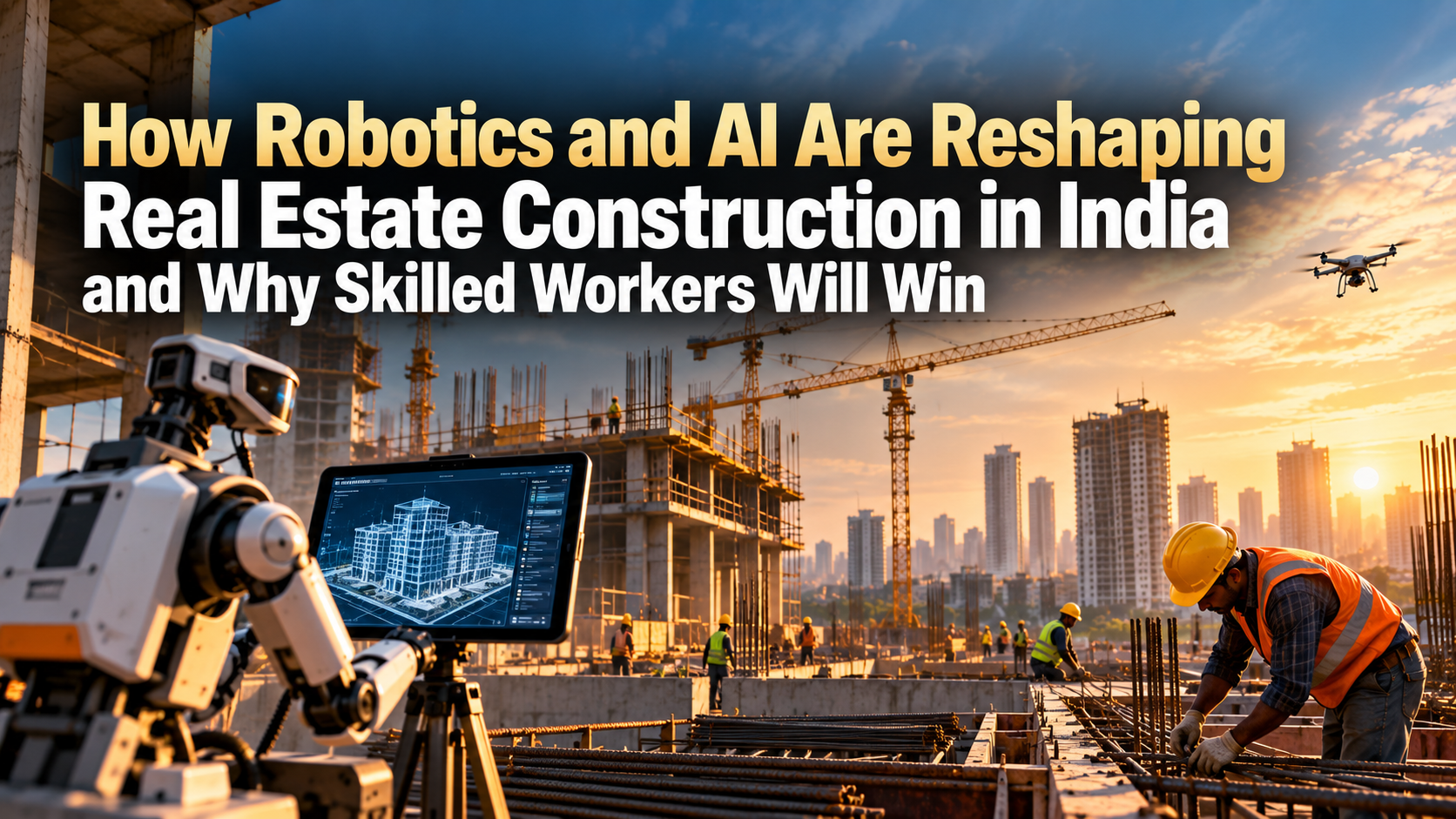
The Indian real estate landscape is expanding at a breakneck pace. With the nation racing toward an ambitious vision of massive urbanization by 2047, developers are facing unprecedented pressure to deliver larger, more complex projects within increasingly tight deadlines. However, the traditional methods of construction—heavily reliant on manual labor and legacy processes—are beginning to strain under this immense demand. To bridge the gap between ambitious development goals and actual execution capacity, the industry is undergoing a silent but profound revolution.
We are officially entering the era of artificial intelligence and robotics in real estate construction. While the sudden influx of autonomous machines on building sites might sound like a premise pulled straight from a science fiction novel, it is rapidly becoming an operational reality. Industry leaders at major real estate conventions across the country have recently highlighted how AI and robotics are actively reshaping the entire property value chain. From the initial design phase to ground-breaking and eventual facility management, technology is stepping in to solve some of the sector’s most persistent challenges.
Yet, this technological leap brings up an inevitable question: what happens to the human workforce? The narrative of machines replacing human labor is a persistent one, but the reality unfolding on construction sites tells a very different story. Instead of mass displacement, the integration of automation is poised to elevate the value of skilled workers, transforming grueling manual jobs into highly specialized, tech-driven careers.
The Shift from Manual Inefficiency to Digital Precision
For decades, global construction productivity has remained largely stagnant, especially when compared to the explosive efficiency gains seen in the manufacturing sector. Building a high-rise apartment complex or a sprawling commercial hub is an incredibly complex logistical puzzle. Material wastage, inconsistent finishing quality, and costly timeline deviations have long been accepted as the normal costs of doing business.
Automation is fundamentally rewriting these rules. The goal is no longer just about building faster; it is about building smarter. When real estate developers deploy digital systems that seamlessly integrate project data from the architectural blueprint all the way to the assembly floor, the efficiency gains are staggering. Recent industry data suggests that leveraging connected digital workflows and off-site modular automation can reduce on-site assembly time drastically, all while delivering a superior, more uniform end product.
One of the most critical advantages of using automated systems is the ability to achieve exact precision. Human error, fatigue, and miscalculations can lead to structural flaws that cost millions to rectify. Digital robotic systems, however, can transfer complex building layouts and floor plans directly onto construction surfaces with pinpoint accuracy. This ensures that every wall, column, and fixture is placed exactly where the architect intended, drastically reducing the need for costly rework and material wastage.
How Robots are Actively Transforming the Job Site
The application of robotics on a modern construction site goes far beyond simple automation; it encompasses a diverse fleet of specialized machines designed to handle distinct phases of the building process. We are now witnessing the emergence of semi-autonomous and fully autonomous equipment that acts as an extension of the human workforce.
Take the early stages of groundwork, for example. Heavy earth-moving machinery, including excavators and bulldozers, are increasingly being outfitted with AI guidance systems. These machines can perform site leveling and excavation with minimal human input, guided by GPS and digital topographical maps. As the structure begins to rise, automated bricklaying systems and large-scale 3D concrete printers take over the repetitive task of wall construction. These machines never tire, they do not need breaks, and they lay material with a consistency that is virtually impossible to achieve manually.
For more intricate structural work, developers are deploying specialized robotics engineered for overhead drilling, rebar tying, and welding. These are tasks that typically require immense physical exertion and precision. Drywall finishing, another notoriously labor-intensive process, is also being handed over to automated systems that can deliver a perfectly smooth, uniform finish across millions of square feet of residential and commercial space.
Simultaneously, the skies above the construction site are getting busier. Agile drones equipped with high-resolution cameras and AI processing capabilities are revolutionizing project management. These aerial vehicles conduct rapid site surveys, monitor daily construction progress, and match the physical build against the digital Building Information Modeling data. This real-time monitoring allows project managers to identify capacity bottlenecks and structural deviations weeks before they become expensive problems.
Elevating Site Safety to Unprecedented Levels
Perhaps the most profound impact of robotics in real estate construction is the dramatic improvement in site safety. It is an unavoidable fact that construction remains one of the most hazardous industries in the world. Human lives are consistently put at risk during various stages of development. Workers operate at dizzying heights, navigate unstable terrain, handle heavy loads, and are exposed to toxic dust and extreme weather conditions.
Robots are fundamentally changing this dynamic by taking over the most physically punishing aspects of construction work. By deploying drones and agile ground robots to conduct structural inspections on scaffolding or deep trenches, developers eliminate the need to expose human workers to potential falls or cave-ins.
Automated heavy-lifting equipment and robotic exoskeletons reduce the chronic physical fatigue and musculoskeletal injuries that have historically plagued manual laborers. When a robot takes over overhead drilling or welding in a confined, poorly ventilated space, the immediate risk to human life plummets. A safer construction site is not just a moral imperative; it is a massive operational advantage that results in fewer work stoppages, lower insurance premiums, and a significantly healthier, more motivated workforce.
Busting the Job Loss Myth: Why Skilled Labor Will Command More Value
Whenever automation enters an industry, the immediate fear is job displacement. In a sector that employs millions of people, this is a valid concern. However, top voices in the real estate industry have drawn a brilliant parallel to clarify the future of construction labor: robotic-assisted surgery.
In modern medicine, an advanced robotic arm can perform highly precise incisions that a human hand simply cannot replicate. Yet, the robot does not replace the surgeon. The machine is a tool that requires the doctor’s deep expertise, supervision, and critical judgment to function safely and effectively. Construction is heading in the exact same direction.
The industry does not need fewer workers; it needs a different kind of worker. The nature of construction employment is shifting from pure manual labor to technical operation and supervision. A worker who previously carried bricks manually might now be trained to program, calibrate, and oversee an automated bricklaying machine. A traditional surveyor is now transitioning into a drone pilot analyzing topographic data through digital interfaces.
This technological transition makes upskilling and reskilling the most critical mandate for the industry today. As machines take over the repetitive, strength-based tasks, human workers are freed up to focus on problem-solving, quality assurance, and complex decision-making. Because these tech-adjacent roles require specialized knowledge, they command higher wages. The construction worker of tomorrow will be a highly valued technician, operating in a safer environment and earning a premium for their digital literacy.
Furthermore, this shift is the key to solving the industry’s looming talent shortage. The younger, digitally native generations have largely shied away from traditional construction jobs due to the grueling physical demands and perceived lack of career progression. However, by transforming the job site into a high-tech environment filled with drones, AI interfaces, and robotics, the real estate sector suddenly becomes a highly attractive career path for young, tech-savvy talent looking to make a massive physical impact on urban development.
Beyond the Build: Automation in Facility Management
The value of robotics and artificial intelligence does not suddenly evaporate once the final coat of paint is applied and the keys are handed over to the buyers. In fact, the technology seamlessly transitions from the construction phase into the long-term lifecycle of the building, fundamentally altering how real estate assets are managed and maintained.
Modern residential townships and massive commercial complexes require immense ongoing upkeep. AI-enabled systems are now being deployed to handle the preventive maintenance of these vast properties. Specialized crawler robots and drones routinely inspect roofs, navigate through complex HVAC ducting, and monitor deep plumbing infrastructure that humans cannot easily access.
These automated inspections can identify micro-leaks, thermal inefficiencies, and minor structural wear long before they escalate into catastrophic failures that inconvenience residents or disrupt corporate tenants. On a daily operational level, autonomous robots are increasingly undertaking routine security patrols, monitoring environmental metrics like air quality, and handling large-scale cleaning tasks in lobbies and parking structures. This ensures that the property maintains its premium value, safety, and operational efficiency decades after the construction crew has left the site.
A Collaborative Future for Indian Real Estate
The message echoing through the corridors of India’s real estate sector is clear: the future of construction is undeniably technology-driven. The integration of artificial intelligence and robotics is not a fleeting trend, but a permanent structural evolution necessary to meet the massive housing and infrastructure demands of a rapidly growing nation.
However, the most successful developers will be those who recognize that this is not a story of humans versus machines. The true potential of this revolution lies in humans working collaboratively alongside machines. Robots bring raw physical strength, tireless repetition, and microscopic precision. Human beings bring critical thinking, adaptability, and the strategic oversight that no algorithm can replicate.
As we look toward the horizon of Indian real estate, the narrative is overwhelmingly positive. Automation will result in homes and commercial hubs that are built faster, safer, and with unparalleled quality. More importantly, it will elevate the people who build them, transforming construction from a labor-intensive grind into a highly skilled, highly valued profession. The technology is here, the machines are powered up, and the future belongs to those ready to guide them.