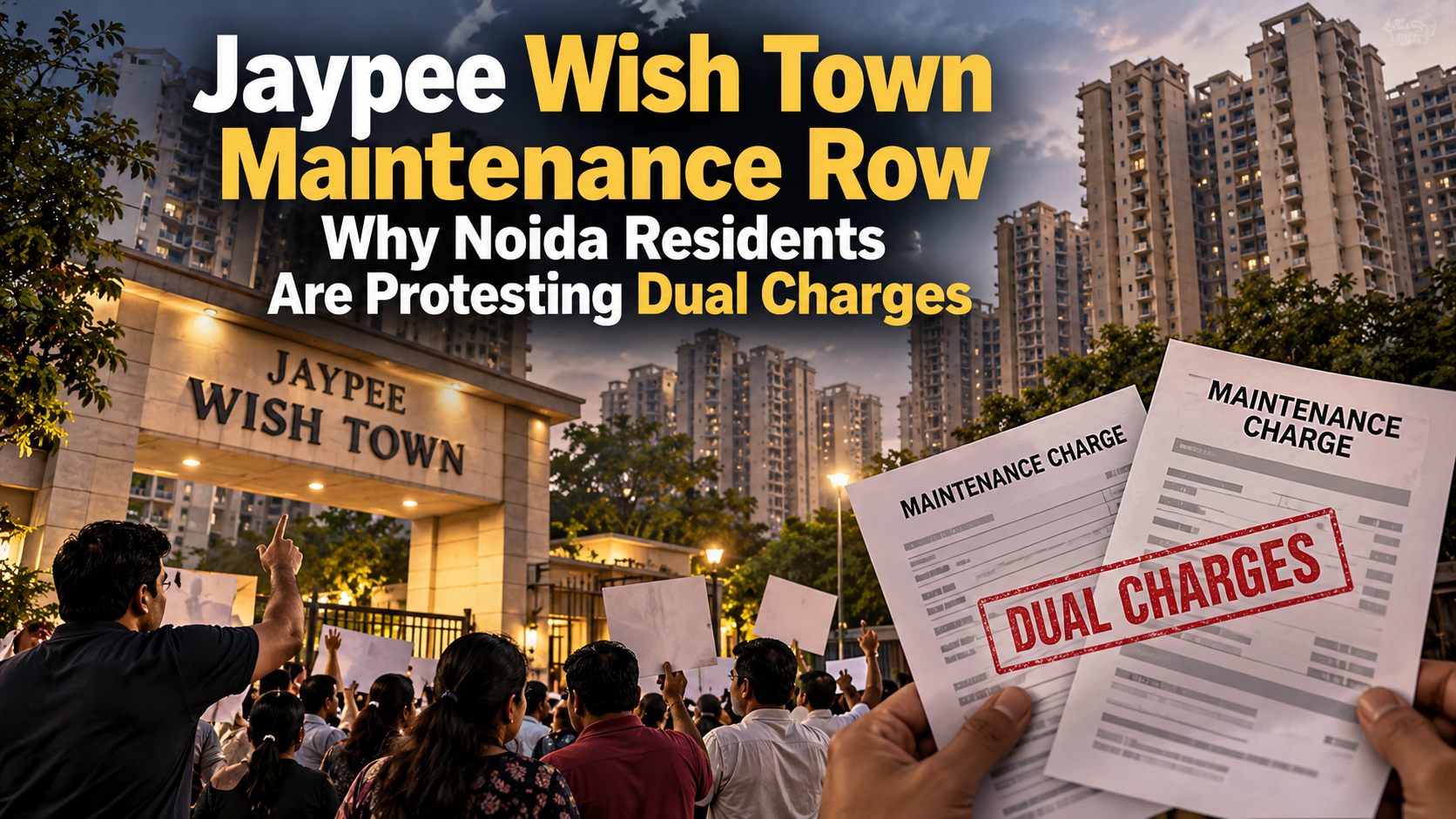
Living in a sprawling, integrated township is often marketed as the pinnacle of modern urban lifestyle. With the promise of manicured landscapes, seamless security, and premium amenities, homebuyers invest a significant portion of their life savings into these mega-projects. However, the realities of post-possession township management can sometimes lead to unexpected financial friction. A prominent example of this unfolding right now is the unrest among the residents of Jaypee Wish Town in Noida, where a recent overhaul of the maintenance fee structure has sparked widespread opposition.
The introduction of an entirely new tier of maintenance charges has not only created a rift between the homeowners and the management but has also raised pertinent questions regarding urban infrastructure management, statutory property laws, and financial transparency in large-scale real estate developments. For anyone invested in the National Capital Region property market, the developments at this premium Noida township serve as a critical case study on homeowner rights and the limits of financial obligations.
The Dual Layer of Financial Obligations
To understand the core of the current unrest, it is essential to look at how maintenance structures are typically designed in group housing societies. Traditionally, residents pay a Common Area Maintenance fee. This pool of funds is explicitly meant to cover the daily upkeep of the immediate residential clusters, ensuring that elevators function, security personnel are deployed, and the corridors remain clean.
In the case of Jaypee Wish Town, homeowners are already contributing to this conventional pool at a rate of ₹3.2 per square foot. However, the situation took a controversial turn when the new management entity, the Suraksha Group, introduced an additional levy categorised as Shared Area Maintenance. Billed at ₹1.5 per square foot, this secondary charge is meant to finance the upkeep of the broader township infrastructure, encompassing the main arterial roads, massive landscaped sectors, and other macro-level amenities that fall outside the immediate residential towers.
For the residents, this dual billing system is a source of immense frustration. The primary argument from the homeowner community is that paying a secondary fee for shared spaces creates a blatant duplication of expenses. From their perspective, the foundational maintenance fee should logically cover the holistic upkeep of the society, and introducing an entirely new category of charges feels like an arbitrary financial imposition.
The Unfair Burden of External Wear and Tear
A major pain point driving the opposition is the actual usage of the shared infrastructure that the new maintenance fee is supposed to cover. A township of this scale does not exist in a vacuum; it is flanked by commercial sectors, industrial zones, and rural belts. Consequently, the arterial roads and shared areas within the project boundary are heavily utilised by a vast demographic of non-residents.
Homeowners have repeatedly pointed out that the internal roads are subjected to intense daily traffic from commercial vehicles and individuals passing through from adjoining rural and industrial areas. Furthermore, because several phases of the township and neighbouring plots are still actively under development, there is a constant influx of heavy construction trucks and earth-moving equipment. It is an undeniable reality that heavy vehicular movement accelerates the deterioration of asphalt roads, damages pavements, and pollutes landscaped green belts.
The residents argue that they should not be financially penalised for the rapid wear and tear caused by external entities and ongoing construction activities. Expecting families who reside in the finished towers to subsidise the repair of roads destroyed by commercial trucks is seen as fundamentally unjust. The burden of maintaining infrastructure that serves a hybrid commercial and industrial purpose, they argue, should be borne by the developers or the commercial entities profiting from that movement, not the residential end-users.
Examining the Legal Framework and Statutory Rights
Whenever a dispute of this magnitude arises in Uttar Pradesh, the lens inevitably shifts to the statutory protections available to homebuyers. The management and maintenance of apartment complexes in the state are governed by the Uttar Pradesh Apartment (Promotion of Construction, Ownership and Maintenance) Act of 2010. This legislation was specifically designed to protect buyer interests and outline the clear methodologies for managing common expenses.
According to the legal provisions, specifically Section 18 of the Act, common expenses are supposed to be allocated among apartment owners strictly in accordance with their undivided interest in the common areas and facilities. The law mandates a proportionate sharing of the financial load based on the property size owned.
However, legal experts and resident welfare advocates have highlighted a significant gray area in the current scenario. While the Act meticulously details standard maintenance protocols, it does not expressly provide for or define a separate, secondary charge like Shared Area Maintenance. Because the terminology and the dual-layered fee structure are absent from the statutory guidelines, residents feel they have a strong legal and moral ground to challenge the new levy. The introduction of fees that lack explicit backing in the prevailing property laws naturally breeds mistrust and prompts demands for a thorough legal review of the management’s billing practices.
The Push for Total Financial Transparency
Beyond the immediate financial sting of the ₹1.5 per square foot charge, the protests at Jaypee Wish Town are deeply rooted in a demand for operational transparency. When management transitions occur in massive real estate projects, homeowners are frequently left navigating a labyrinth of revised terms and conditions.
The residents are demanding that the management open its books. They want a clear, granular breakdown of how the existing maintenance funds are being utilised and exactly what specific expenses necessitate an additional levy. There is a strong collective demand to see a direct comparison between the old maintenance agreements and the newly proposed structure. By making the calculation methods and expenditure records public, the homeowners hope to establish whether the new charges are a genuine necessity for the township’s survival or an engineered method to boost operational margins.
Without this transparency, the community remains steadfast in its refusal to accept the new charges. The threat of intensifying the agitation looms large, with residents warning that peaceful demonstrations will escalate if their demands for a fair audit and public disclosure are ignored.
Regulatory Intervention and the Path to Mediation
Recognising the volatility of the situation and the large number of families impacted, the local administration has had to step in. The matter was recently escalated to the highest echelons of the Noida Authority. Following intense lobbying by the society’s representative committees, the Authority’s leadership acknowledged the gravity of the homeowners’ grievances.
Directives have been issued by the Noida Authority’s top executives to initiate a structured dialogue between the disputing parties. Subordinate officials have been tasked with convening joint meetings bringing together the resident representatives, the township’s security and facility management, and the developers.
The involvement of the Noida Authority is a crucial development. As the principal planning and regulatory body for the city, the Authority possesses the leverage to enforce fair practices and ensure that private estate management operates within the bounds of regional laws. For the residents, the Authority’s intervention provides a platform to negotiate a sustainable resolution, ensuring that their voices are heard in an official, documented capacity rather than just on the protest lines.
Broader Implications for the Real Estate Ecosystem
The conflict at Jaypee Wish Town is not an isolated local issue; it is a bellwether for the broader real estate market across the National Capital Region and beyond. As cities expand vertically and horizontally, the integrated township model is becoming the standard for urban living. These mega-projects function almost like independent municipal zones, requiring vast resources to maintain their internal ecosystems.
However, the regulatory frameworks governing these private townships are frequently outpaced by the operational realities on the ground. When developers hand over the reins to facility management companies, the primary objective often shifts towards aggressive cost recovery. If the dual-tier maintenance model being pushed in this scenario is allowed to pass without scrutiny, it could easily set a precedent for other developers across the region to introduce fragmented, multi-layered maintenance bills.
Prospective homebuyers observing this dispute are likely to become far more cautious. The ongoing friction highlights the absolute necessity for buyers to scrutinise every clause related to post-possession charges before signing a builder-buyer agreement. It underscores the importance of having ironclad definitions of what constitutes a common area and exactly what financial liabilities a homeowner will bear a decade down the line.
Fostering a Collaborative Community Environment
For a township to thrive, the relationship between the homeowners and the management must be built on a foundation of mutual trust and shared goals. The current standoff is detrimental to both sides. For the residents, continuous protests and administrative battles lead to a stressful living environment and potential neglect of the property’s upkeep. For the management group, a hostile resident base can lead to massive defaults on fee collections, tarnishing the brand’s reputation and stalling the overall development of the remaining phases.
The resolution to this dispute lies in equitable compromise and open communication. Management entities must recognise that homeowners are not infinite revenue streams but vital stakeholders in the project’s long-term success. Any revision in financial structures must be preceded by extensive consultations, town hall discussions, and unquestionable financial transparency.
Conversely, maintaining a premium township of this scale is a capital-intensive endeavour, and the genuine costs of upkeep cannot be ignored. If an independent audit proves that the existing funds are insufficient to maintain the lifestyle promised to the buyers, a restructured fee might be necessary. However, this must be done fairly, ensuring that the financial burden of external wear and tear—such as construction traffic and commercial use—is completely ring-fenced from the residential billing cycle.
As the meetings mediated by the Noida Authority get underway, the real estate community watches closely. The outcome of the Jaypee Wish Town maintenance dispute will likely serve as a defining benchmark for how resident welfare, statutory property laws, and corporate estate management intersect in the modern era of Indian real estate.