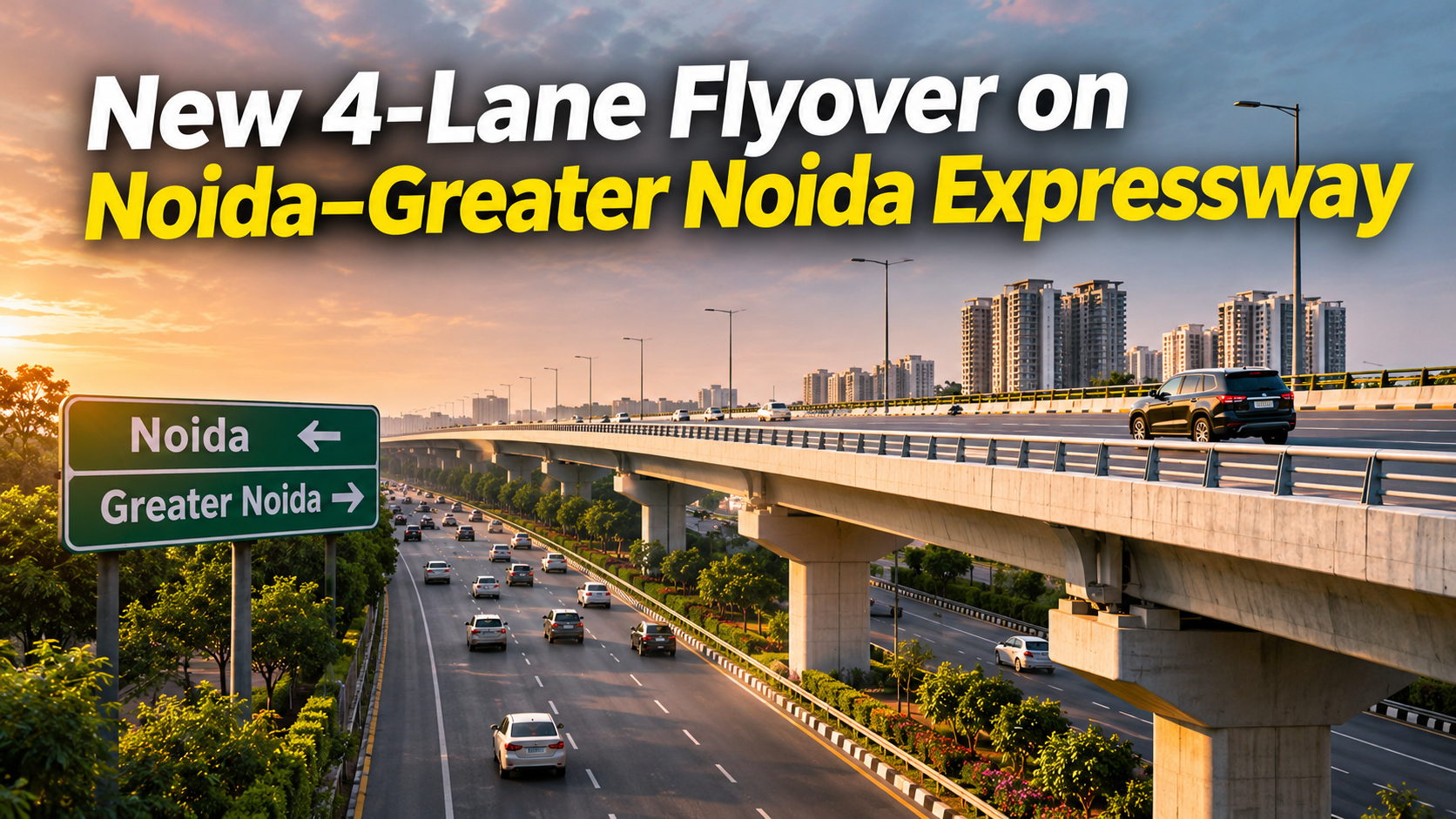
Anyone who drives along the southern stretch of the Noida-Greater Noida Expressway during morning or evening peak hours knows how quickly a smooth commute can grind to a halt. While the 24-kilometer high-speed corridor was built to connect Delhi, Noida, and Greater Noida effortlessly, rapid residential and commercial growth around Sectors 148 to 153 has placed heavy pressure on its local crossing points. Commuters trying to move between residential townships on one side and office hubs or metro stations on the other routinely lose fifteen to twenty minutes idling near jammed underpasses.
To fix this recurring bottleneck, the Noida Authority is moving forward with a dedicated four-lane flyover directly across the Noida-Greater Noida Expressway. Backed by an estimated budget of Rs 84.16 crore, the upcoming elevated link will connect Sector 148 and Sector 150, giving daily office-goers, local residents, and nearby village commuters a direct overhead passage without having to merge into expressway traffic or take long detours.
With the Detailed Project Report (DPR) currently undergoing technical scrutiny at IIT Roorkee, this infrastructure upgrade is shaping up to be one of the most practical traffic-relief projects in southern Noida. Beyond cutting down commute times, the flyover is already drawing fresh attention from homebuyers and investors tracking the Sector 150 and Noida Expressway real estate market.
Project Overview: Design, Length, and Cost of the New Noida Expressway Flyover
Unlike conventional concrete overpasses that rely on heavy central piers, the planned Sector 148 to Sector 150 flyover features a modern pillarless arch design. Engineering a pillarless span over an active six-to-eight-lane expressway is a deliberate choice. By eliminating bulky concrete pillars in the middle of the highway, the Noida Authority ensures that main carriageway lanes remain completely unobstructed, preserving high-speed traffic flow underneath while improving visibility and road safety.
The structure is planned with a total length of approximately 610 meters and a width of 9.5 meters, allowing comfortable four-lane two-way vehicular movement. Within that total span, the main arch bridge crossing directly over the Noida-Greater Noida Expressway will measure around 65 meters. The remaining 545 meters will consist of well-graded approach roads and entry-exit ramps designed to keep merging smooth and prevent queues from spilling onto sector roads.
The total project cost is pegged at Rs 84.16 crore. Once the technical audit is cleared, the Noida Authority will float tenders to appoint a construction agency, after which groundwork will begin.
Route Alignment and Why the Existing Underpass Falls Short
The new flyover is strategically positioned to create a clean, direct bridge between Sector 148 and Sector 150 right across the Noida-Greater Noida Expressway. Understanding why this specific alignment matters requires looking at how traffic currently moves through the area.
Right now, residents of Sector 150 and neighboring sectors have to rely heavily on the existing underpass to cross over to the Sector 148 side, which houses the Sector 148 Metro Station on the Aqua Line along with major arterial links toward Greater Noida. The current underpass lacks dedicated directional cuts for smooth cross-sector movement. As a result, drivers frequently have to travel an extra kilometer back and forth just to make a U-turn or join the right service lane.
During office rush hours, school timings, and monsoon waterlogging spells, this single crossing point turns into a major choke point. Long queues of cars, cabs, and two-wheelers back up onto the service roads, slowing down both local residents and highway traffic. By introducing a dedicated overhead corridor, the four-lane arch flyover splits traffic cleanly. Local cross-expressway commuters can glide straight over the highway between Sector 148 and Sector 150, immediately taking pressure off the ground-level underpass.
Who Benefits Most: Sectors and Villages Getting Direct Traffic Relief
The impact of the new 4-lane flyover on the Noida-Greater Noida Expressway reaches far beyond just two sectors. According to planning estimates, the elevated link will bring daily commute relief to roughly 2 to 2.5 lakh office-goers and residents living across southern Noida.
More than six major residential and institutional sectors stand to benefit directly, including Sector 148, Sector 149, Sector 150, Sector 151, Sector 152, and Sector 153. For families living in the sprawling high-rise societies of Sector 150, reaching the Sector 148 Aqua Line metro station or heading toward Greater Noida Knowledge Park and Pari Chowk will become noticeably faster and less stressful.
In addition to urban sectors, around twenty nearby villages located along the Yamuna Khadar belt and the southern edge of the expressway will gain safer, quicker road connectivity. Villagers commuting for work, education, or agricultural trade will no longer have to navigate congested service-lane detours just to cross the expressway.
Current Status: IIT Roorkee Technical Review and Next Steps
Before heavy construction begins over a major high-speed corridor like the Noida-Greater Noida Expressway, structural and traffic safety checks are mandatory. The Noida Authority has already prepared and submitted the Detailed Project Report for the 610-meter flyover to the civil engineering experts at IIT Roorkee for independent technical scrutiny.
The review at IIT Roorkee examines load-bearing calculations for the 65-meter pillarless arch span, ramp gradients, soil stability, and traffic management plans during the construction phase. Because the bridge crosses an operational expressway carrying tens of thousands of vehicles daily, ensuring minimal disruption during girder and arch installation is a top priority.
Once IIT Roorkee grants final technical approval, the Noida Authority will move into the tendering stage to select an experienced infrastructure contractor. While exact completion dates will be finalized once the tender is awarded and site mobilization starts, the administrative momentum behind the project signals that southern Noida’s congestion issues are being treated as a priority.
The Bigger Picture: Noida-Greater Noida Expressway and Parallel Decongestion Plans
Running roughly 24 kilometers from the Mahamaya Flyover near Sector 94 down to Pari Chowk in Greater Noida, the Noida-Greater Noida Expressway is the economic spine of the region. Flanked by wide service lanes, major IT parks, corporate campuses, universities, and dense residential clusters, it handles massive daily traffic between Delhi, Noida, Greater Noida, and the Yamuna Expressway.
The Sector 148 to Sector 150 flyover is not an isolated fix. It fits into a wider network of road upgrades designed to future-proof the corridor as the Noida International Airport in Jewar and surrounding industrial zones bring even more vehicles onto NCR roads.
Alongside this Rs 84.16 crore flyover, the Noida Authority has also approved a major Rs 500 crore alternative road project spanning roughly 29 kilometers along the Yamuna Pushta and Doab belt. Designed as a four-lane parallel corridor combining upgrades to existing stretches and a brand-new 17-kilometer link extending toward Sector 150 and Kondli-Bangar, that parallel road is intended to absorb local and cross-sector traffic from Sectors 94, 124 to 135, 150 to 155, 158, 159, 163, 164, and 168. Together, the parallel highway and the new Sector 148 to 150 arch flyover will give commuters multiple ways to navigate southern Noida without clogging the main expressway.
Real Estate Impact: How the New Flyover Boosts Sector 150 and Nearby Markets
In NCR real estate, physical connectivity is the single biggest driver of both end-user livability and long-term capital appreciation. Whenever a persistent traffic bottleneck is resolved, surrounding micro-markets tend to see a quick uptick in buyer confidence, and the Sector 148 to Sector 150 belt is already reflecting this trend.
Renewed Momentum for Sector 150
Sector 150 has long been positioned as Noida’s greenest, lowest-density residential destination, planned around wide open spaces, sports infrastructure, and upscale gated communities. Homebuyers looking for spacious 3 BHK and 4 BHK apartments in Noida have consistently favored Sector 150 for its clean layout, parks, and upcoming sports facilities such as tennis courts, cricket academies, swimming pools, and indoor arenas. The main hesitation for many office-goers was the daily bottleneck when exiting the sector toward the expressway or metro. A direct four-lane flyover linking straight to Sector 148 removes that friction, making ready-to-move and under-construction homes in Sector 150 far more practical for daily commuters working in Noida’s IT hubs or Delhi.
Rising Appeal of Mid-Segment and Affordable Corridors
The real estate ripple effect is not limited to luxury developments. Neighboring pockets like Sector 148, Sector 151, and Sector 152 are attracting young working professionals and budget-conscious families searching for well-connected 2 BHK flats close to employment centers. Easier cross-expressway access improves rental demand as well, since tenants prioritize shorter door-to-metro and door-to-office travel times when choosing between competing societies.
Commercial and Retail Growth Along Feeder Roads
Commercial real estate thrives on effortless accessibility. High-street retail shops, neighborhood plazas, office spaces, and mixed-use commercial hubs around Sectors 148, 150, and 152 stand to gain higher footfall once commuters no longer avoid the area during peak traffic hours. Smoother feeder roads also strengthen the appeal of the southern Noida Expressway belt for corporate tenants looking for alternatives to congested central Noida sectors.
What Homebuyers and Investors Should Watch Next
For anyone evaluating residential or commercial property along the Noida-Greater Noida Expressway, tracking infrastructure execution is just as important as checking project brochures. With the DPR under review at IIT Roorkee, the next key milestones to watch are final technical clearance, tender award, and the start of foundation work on the approach ramps.
Properties located near planned connectivity upgrades often experience two waves of value growth: an initial rise in buyer interest once approvals and tenders are confirmed, and a stronger, more sustained jump in both resale values and rental yields once the flyover opens to traffic. Buyers considering flats in Sectors 148 to 153 should weigh this upcoming connectivity boost alongside builder track records, RERA compliance, possession timelines, and proximity to the Aqua Line metro.
A Timely Upgrade for Southern Noida’s Fastest-Growing Corridor
The planned four-lane arch flyover between Sector 148 and Sector 150 addresses one of the most tangible everyday pain points on the Noida-Greater Noida Expressway. By combining a pillarless 65-meter main span with 545 meters of well-planned approaches at a cost of Rs 84.16 crore, the project delivers targeted congestion relief without disturbing the main expressway lanes below. Once cleared by IIT Roorkee and built, it will save thousands of commuters valuable time every single day, connect twenty surrounding villages more safely to urban Noida, and reinforce the long-term residential and commercial appeal of the entire southern expressway corridor.