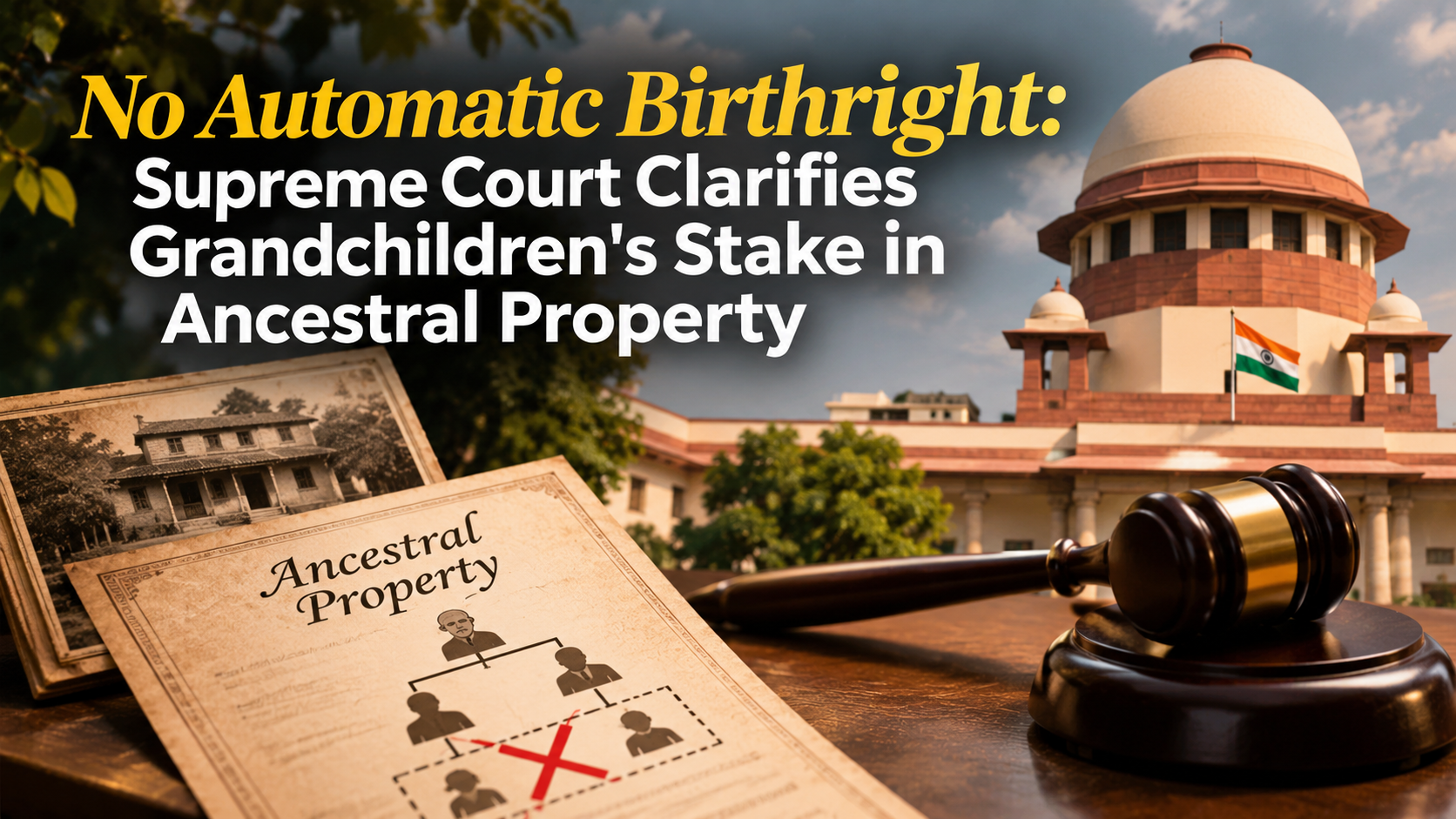
Property inheritance in India is often surrounded by deep-rooted cultural beliefs and traditional assumptions, particularly when it comes to the concept of ancestral wealth. For generations, there has been a widespread understanding that the moment a child is born into a Hindu family, they automatically acquire a legal right to a share of their grandfather’s estate. While this concept of birthright was once a central pillar of the traditional Mitakshara school of Hindu law, modern statutory frameworks have significantly altered how property is inherited, partitioned, and owned.
A recent landmark judgment by the Supreme Court of India has brought much-needed clarity to this complex area of real estate and family law. The judicial bench firmly established that simply because a piece of real estate originally belonged to a grandparent, it does not mean the grandchildren have an automatic, legally enforceable claim to it. The ruling specifically addressed the legal status of property that devolves upon a son after the death of his father without a will, and what happens to that property once it is partitioned among the legal heirs.
Understanding this legal distinction is absolutely vital for property owners, potential real estate investors, and families navigating the delicate process of estate planning. The judgment draws a hard line between traditional joint family property and property inherited in an individual capacity, fundamentally changing how subsequent generations must view their inheritance prospects.
Decoding the Legal Nature of Ancestral Versus Inherited Property
To fully grasp the magnitude of this legal clarification, one must look at the historical context of property laws governing Hindu families. Historically, the Mitakshara legal system dictated that a son, grandson, and great-grandson acquired a joint interest in ancestral property simply by virtue of being born. In this traditional setup, the property belonged to the Hindu Undivided Family as a collective entity, and the head of the family merely acted as a manager. He could not sell or transfer the property without the explicit consent of the other coparceners, except in cases of extreme legal or family necessity.
However, the legal landscape underwent a massive transformation with the enactment of the Hindu Succession Act in 1956. The legislature intentionally sought to modernize inheritance rights, moving away from perpetual joint family ownership and toward a system that favored individual, absolute property rights.
The core of the recent Supreme Court clarification revolves around the difference between property governed by survivorship and property governed by statutory succession. When a Hindu male dies intestate, meaning without leaving a valid will, his separate or self-acquired property is distributed among his Class I legal heirs according to the rules of succession. The property does not automatically merge into a joint family pool. Instead, the law mandates that the heirs receive their respective shares in their individual capacities.
Once this inherited property is formally partitioned and allotted to a specific heir, it loses any lingering ancestral character. It becomes the exclusive, separate property of the person who inherited it. The judicial interpretation makes it clear that the traditional concept of a grandson’s birthright does not survive or carry over into property that has been distributed under these specific statutory provisions.
The Real-World Dispute That Led to the Supreme Court Clarification
The legal principles surrounding this issue were recently put to the test in a prolonged property dispute originating in southern India, which eventually reached the highest court in the country. The case involved a classic scenario of family property division and the subsequent friction between a father and his son regarding ownership rights.
The origins of the dispute date back to the death of a property owner whose estate was left intestate. Following his passing, a partition suit was initiated by his daughter in the early 1990s to divide the estate among the legal heirs. Through a formal compromise decree executed a few years later, a specific residential plot measuring just over eighteen hundred square feet was legally allotted to one of the deceased man’s sons.
A few years after taking full possession of his allotted share, the son decided to liquidate the asset and sold the plot to third-party buyers. This transaction triggered a major legal battle when the seller’s own minor son, acting through his mother, filed a lawsuit challenging the sale. The minor son demanded a formal partition of the plot, claiming that because the property originally belonged to his grandfather, he possessed a birthright to a half-share of the land as a coparcener. He argued that his father had no legal authority to sell the entire property without his consent and without proving a strict legal necessity for the family.
The legal journey of this dispute was highly contested. The initial trial court surprisingly ruled in favor of the grandson, granting a preliminary decree that recognized his claim to the property. However, this decision was swiftly overturned by the First Appellate Court, and the reversal was subsequently upheld by the Madras High Court. The grandson eventually appealed to the Supreme Court, setting the stage for a definitive ruling on the intersection of birthrights and partitioned inheritance.
After carefully reviewing the timeline and the applicable laws, the Supreme Court dismissed the grandson’s appeal entirely. The judicial bench validated the father’s sale of the property, reinforcing the legal reality that the father was the absolute and exclusive owner of the land he had inherited.
How Statutory Succession Redefines Class I Heirs
The foundation of the Supreme Court’s reasoning lies within a specific section of the Hindu Succession Act that dictates how a Hindu man’s property is distributed when he dies without a will. This provision establishes a clear hierarchy of inheritance, starting with Class I legal heirs.
The statutory schedule explicitly lists the individuals who qualify as Class I heirs, which includes the deceased man’s mother, widow, sons, and daughters. A critical detail that the court highlighted is the explicit exclusion of a grandson from this primary list if the grandson’s father is still alive. While the son of a pre-deceased son is given Class I status to ensure the lineage is not disinherited by a premature death, a grandson whose father is alive and inheriting property directly has no independent standing in that specific succession event.
Because the grandson is not recognized as a Class I heir under these circumstances, he cannot claim a direct right to the grandfather’s estate. The property bypasses the grandson entirely and vests absolutely in the father. The judicial bench noted that the legislature, when drafting the inheritance laws in the mid-twentieth century, deliberately chose not to save the traditional Mitakshara birthright for a son’s son when property devolves through intestate succession.
Therefore, when the father in the disputed case received his designated plot through the partition decree, he did not receive it as a manager or a trustee for his future descendants. He received it as an absolute owner. As the sole owner, he possessed the unencumbered right to manage, develop, or alienate the property, including selling it to a third party without seeking permission from his children.
The Myth of Automatic Rights by Birth in Modern Real Estate
A major point of contention in many family property disputes is the timeline of births relative to the legal partition of an estate. In the case reviewed by the Supreme Court, the grandson was born just a month before the final compromise decree that officially partitioned the grandfather’s property was executed. The appellant attempted to use this timeline to argue that his birth prior to the formalization of the partition automatically generated a coparcenary right in the estate.
The court systematically dismantled this argument by focusing on exactly when the succession actually opened. In property law, succession opens the moment the original owner passes away. Because the grandfather died and the partition proceedings began well before the grandson was even born, the property had already legally devolved upon the Class I heirs under statutory law.
The physical division of the land and the final paperwork merely formalized the shares that had already vested in the heirs individually. The grandson’s birth during the administrative finalization of the partition did not magically convert the father’s individual inheritance back into a joint family asset.
This establishes a firm legal precedent that the timing of a child’s birth cannot retroactively alter the nature of property that has already passed through the channels of statutory succession. Once the chain of joint coparcenary ownership is broken by intestate succession and subsequent partition among Class I heirs, the property remains separate and individual. It does not revert to ancestral status simply because the new owner decides to have children.
Real Estate Market Implications and Buyer Protection
Beyond the realm of family dynamics, this judicial clarification has massive implications for the broader real estate market, particularly concerning title verification and buyer safety. Property transactions in India are frequently delayed or derailed by fears of lingering ancestral claims. Buyers are often hesitant to purchase land or homes from individual sellers if they discover the property was inherited from a grandparent, fearing that the seller’s children might emerge years later to challenge the sale and claim a birthright.
The Supreme Court ruling serves as a powerful shield for bona fide property purchasers. It provides legal certainty that if a seller acquired a property as an allotted share during the partition of a deceased parent’s intestate estate, that seller is the absolute legal owner. Real estate investors and individual homebuyers can confidently proceed with such transactions, knowing that a grandson or daughter cannot successfully file a lawsuit to reopen the sale or demand a share of the property years down the line.
For legal professionals and due diligence teams working on property acquisitions, the focus shifts to verifying how the property devolved to the current seller. If the title traces back to a partition deed executed among Class I heirs following an intestate death, the title is considered clean and marketable. The buyer does not need to secure no-objection certificates or relinquishment deeds from the seller’s children, streamlining the transaction process significantly.
This level of clarity prevents malicious litigation where family members collude to challenge legitimate property sales long after the buyer has paid the consideration and taken possession. By affirming the father’s absolute right to alienate his individual property, the court has bolstered the security of real estate investments and enhanced the overall fluidity of property transfers in the market.
Strategic Property Planning and Family Wealth Management
The dismissal of the grandson’s claim serves as a critical educational moment for families navigating wealth transfer and estate management. It highlights the urgent need to move away from assumptions based on outdated traditional laws and toward formal, documented property planning.
Individuals who wish to ensure that their wealth flows down to their grandchildren without giving absolute alienation rights to the immediate next generation must actively utilize legal instruments like wills and trusts. If a property owner wants to restrict their son from selling an inherited asset and ensure it passes to the grandchildren, they cannot rely on intestate succession laws to enforce that desire. They must draft a comprehensive will that clearly defines life interests or sets up a private trust to manage the asset across generations.
Conversely, individuals who have inherited property through partition must recognize their absolute ownership status. They have the freedom to utilize the equity in that real estate to fund business ventures, pay for higher education, or upgrade to better properties without being legally hindered by their children’s hypothetical claims.
Ultimately, the legal landscape surrounding property rights heavily favors documented intentions and statutory frameworks over traditional assumptions. The highest court in the country has made it exceptionally clear that the concept of an ancestral birthright has strict limitations in modern law. For grandchildren, the path to acquiring family wealth relies entirely on the individual choices and estate planning decisions of their parents, rather than an automatic legal entitlement granted at birth.