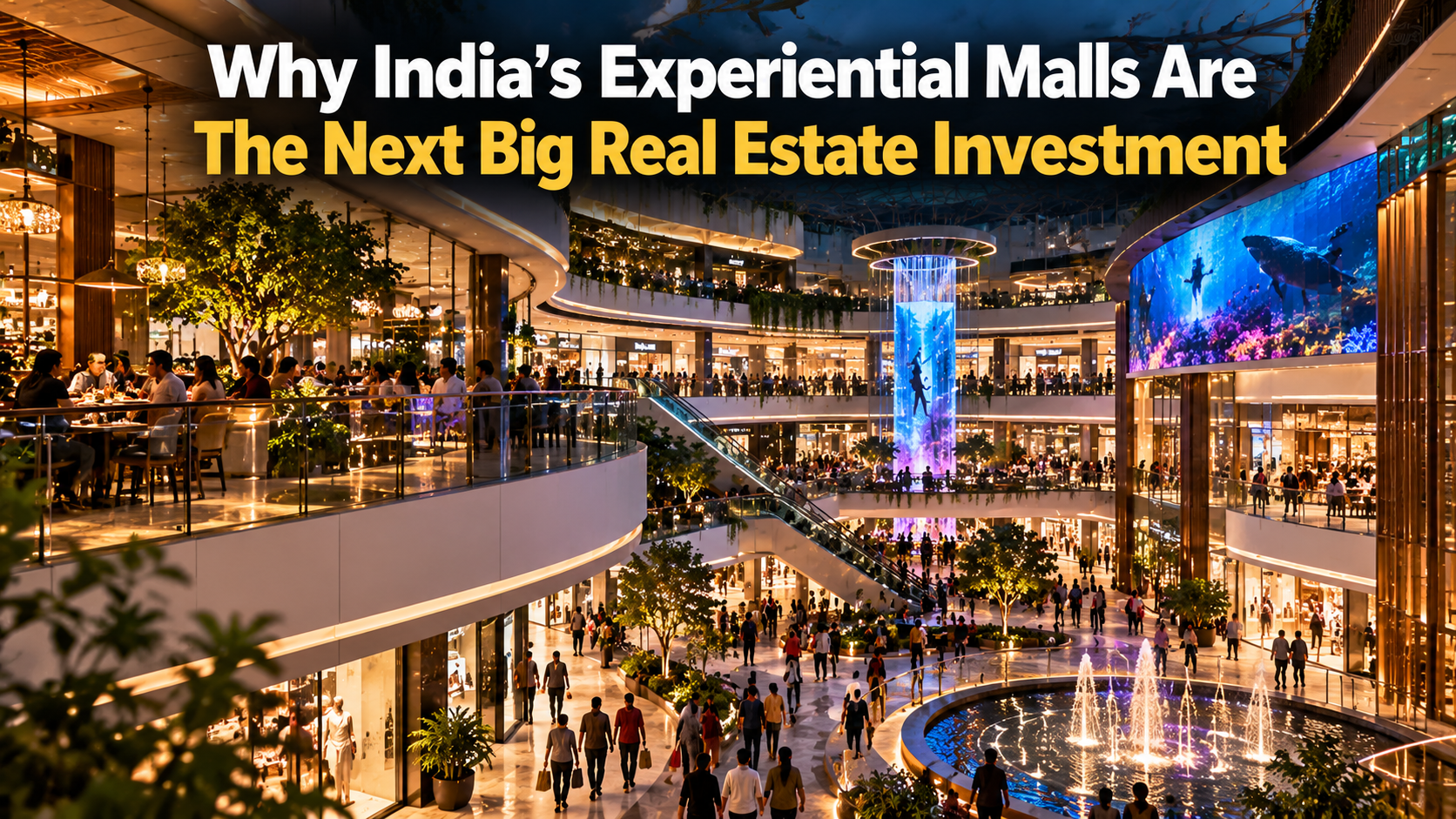
A modern shopping mall in India is no longer just an air-conditioned corridor lined with stores selling clothes, groceries, or household essentials. Driven by a rapidly expanding middle class and a shift in urban lifestyle preferences, these vast commercial spaces are increasingly serving as holistic destinations for dining, high-octane entertainment, socialising, and discovering emerging digital-first brands. From sprawling speciality restaurants and immersive indoor gaming zones to massive family entertainment centres, modern retailers are entirely rethinking the role of physical brick-and-mortar spaces in an era dominated by smartphone swiping and digital marketplaces.
For commercial property investors, this massive shift towards experience-led retail brings an array of fresh opportunities, alongside complex new questions regarding occupancy stability, tenant performance, and sustainable rental income. This transformation has far-reaching implications well beyond the retail industry itself. It is fundamentally reshaping the Indian retail real estate market, a sector where the underlying financial performance of a shopping centre is now completely dependent on its ability to attract customers, increase their dwell time, and subsequently generate sustainable, appreciating rental yields.
For those exploring structured investment avenues like Real Estate Investment Trusts, this dynamic creates a highly attractive intersection between India’s macroeconomic consumption story and income-generating commercial property. Understanding this relationship, however, requires looking past the glossy storefronts. The connection is not as simple as higher consumer spending automatically translating into higher property returns. It requires a deep dive into recent retail leasing trends, tenant economics, and the precise ways these operational factors influence the long-term performance of a commercial real estate portfolio.
The Numbers Behind the Retail Leasing Surge
To grasp the magnitude of shopping mall investments today, one must look at the underlying market data. The Indian real estate market is currently in a hyper-growth phase, expanding rapidly toward an estimated valuation of over $1.2 trillion by the early 2030s. Within this massive ecosystem, the retail real estate sector is proving to be exceptionally resilient. The scale of recent leasing activity perfectly highlights the unyielding demand for high-quality, organised retail space.
Recent market dynamics from the second half of 2026 reveal that gross retail leasing across India’s top urban markets has consistently breached the multi-million square foot mark, demonstrating double-digit percentage growth compared to previous years. Demand for prominent, high-visibility retail locations remains incredibly strong, even as the market digests new Grade A mall supply. Furthermore, shopping mall vacancy rates across major metropolitan areas have seen a healthy decline, dropping closer to the 11% mark broadly, with premium Grade A malls in prime city centres seeing vacancy rates plummet below 5%.
These figures firmly suggest that demand for organised retail environments remains highly relevant to retailers aggressively expanding their physical footprints. Domestic retailers are currently leading the charge, accounting for the vast majority of leasing activity, reflecting a massive push by home-grown brands to capture local market share. But the underlying story is not just about raw square footage; it is deeply tied to the kind of space businesses want and the specific lifestyle experiences they are desperate to offer their customers.
The Rise of Experience-Led Spaces
The explosive growth of e-commerce and quick-commerce delivery models has permanently altered the expectations associated with physical retail. Consumers can effortlessly purchase most commodities online, making the in-person visit an increasingly critical part of a retailer’s value proposition. A consumer may visit a retail centre for a specific purchase, but they will likely stay to dine at a popular restaurant, watch a newly released film, visit a virtual reality gaming centre, or explore a flagship experiential store.
Shopping centres are rapidly responding by engineering their floor plans to bring multiple lifestyle activities under one roof. For modern retailers, these premium locations provide unparalleled brand visibility, direct customer engagement, and opportunities to create tactile experiences that are entirely impossible to replicate through a digital storefront.
For mall operators, the ongoing challenge is to curate a tenant mix that guarantees repeat weekend visits while making the most efficient financial use of the available leasable area. Dining, entertainment, and leisure facilities serve as anchor attractions that complement conventional retail stores, vastly extending the hours customers spend on the premises and supporting collateral demand for neighbouring outlets.
Recent industry figures tracking the Indian retail sector highlight that while fashion and apparel still account for roughly a third of all retail leasing, food and beverage operations and entertainment spaces are rapidly capturing larger market shares, moving closer to 18% and 16% respectively. Additionally, direct-to-consumer digital brands are aggressively expanding into physical retail as part of their customer acquisition strategies.
However, hosting experience-led retail does not automatically guarantee commercial success. Entertainment facilities require heavy capital investment, specialized structural requirements, and intensive property management. Their ultimate contribution to a property’s financial performance depends entirely on tenant economics, meticulously structured leasing arrangements, and the operator’s ability to pull consistent footfall regardless of the economic season.
Translating Footfall into Durable Rental Income
For a retail property owner, the relationship between a bustling mall concourse and actual financial performance always runs through the tenants occupying the space. Retailers assess potential locations based on specific catchment demographics, historical footfall data, brand positioning, overhead rental costs, and the ultimate potential to generate robust sales per square foot. A mall that manages to attract the right target audience will always be better placed to retain its tenants and secure long-term leasing commitments.
When a commercial property maintains healthy occupancy with top-tier brands, it creates a predictable stream of rental receipts. Lease renewals, agreements with incoming tenants, and pre-contracted rent escalations all play a pivotal role in driving the growth of rental income over a financial year.
Yet, high occupancy alone does not tell the complete story. A property might boast a fully occupied floor plan while secretly facing severe downward pressure on rents, offering massive tenant incentives, or struggling with inflated operating expenses. Conversely, a mall actively investing in refurbishment or repositioning might temporarily experience higher vacancies as it intentionally clears out underperforming brands to prepare for a more lucrative tenant mix.
Therefore, the quality, structure, and durability of the rental income matter just as much as the headline occupancy figure. For those looking at shopping mall investments, understanding how the underlying properties actually generate cash, what it costs to maintain them, and how broader leasing trends affect the bottom line is absolutely essential.
Enter the Retail REIT: Democratising Commercial Property Investment
Direct ownership of a sprawling, multi-acre shopping centre is entirely beyond the financial reach of individual investors and involves staggering operational responsibilities. Retail-focused Real Estate Investment Trusts provide an accessible, highly regulated route to gain exposure to prime commercial property without the headaches of direct management.
Under India’s stringent regulatory framework governed by the Securities and Exchange Board of India, REITs pool capital to acquire, manage, and scale portfolios of income-generating real estate assets, subsequently issuing units to investors. These listed units can be actively traded on stock exchanges, providing crucial liquidity.
For investors interested in the India retail real estate growth story, the primary attraction of a REIT lies in participating in the financial upside of professionally managed, Grade A urban consumption centres. India’s listed retail REIT sector has demonstrated impressive resilience, with major managed portfolios reporting strong double-digit consumption growth across key categories like fashion, electronics, and beauty, translating into steady dividend payouts and robust net operating income growth.
However, exposure to retail real estate through a trust should never be confused with a direct investment in consumer spending. If a retailer’s sales surge by 20%, it does not mean the rent paid to the landlord increases by the same margin. The precise terms of the lease, the financial health of the tenant, and the property owner’s fixed costs completely dictate this relationship. A mall’s local popularity does not magically translate into higher REIT distributions; investors must rigorously assess the trust’s actual financial performance and the underlying valuation of its combined assets.
Metrics That Matter for Retail Property Investors
The rapidly shifting retail landscape makes it vital to look far beyond the sheer number of cars in the parking lot or the pace of new store inaugurations. Evaluating the quality of a retail real estate portfolio requires a clinical look at several operational indicators.
Occupancy and leasing trends remain the first line of evaluation. It is necessary to examine exactly how much of the available gross leasable area is currently occupied, how that figure has trended over the past few quarters, and whether vacant units are being quickly absorbed at competitive market rates.
Tenant mix and concentration risk are equally critical. A well-balanced combination of fast fashion, premium apparel, food and beverage, and entertainment broadens a property’s mass appeal. Investors should pay close attention to any over-reliance on a single major anchor tenant or a specific retail category, as localized changes in consumer trends could disproportionately affect leasing demand.
Lease expiries and rental growth potential dictate future cash flows. The timing of lease renewals offers a window into future income predictability. Reviewing contractual rent escalations and the mark-to-market potential—the ability to lease expiring space at much higher current market rates—gives a clear picture of a property’s earning trajectory.
Furthermore, property investment and operating costs cannot be ignored. Modern shopping centres demand continuous capital expenditure on structural maintenance, aesthetic refurbishment, and the integration of new consumer amenities. While these capital investments support long-term market competitiveness, they directly impact the immediate free cash flow available to the property owner or the REIT’s unitholders.
Navigating the Risks of the Consumption Opportunity
While India’s organised retail market stands to benefit massively from changing consumer preferences and aggressive brand expansion, the sector is not immune to distinct economic and operational risks.
Any broader macroeconomic slowdown in discretionary spending will immediately affect retailers’ sales volumes and their future expansion appetites. Simultaneously, rising operating costs—such as energy tariffs, property taxes, and facility management overheads—can put immense financial pressure on tenants. Moreover, the introduction of competing premium malls in the same micro-market can severely cannibalize local footfall, directly influencing occupancy rates and pricing power.
The relentless growth of the digital economy, specifically quick commerce, affects different retail categories in highly nuanced ways. While some modern retailers expertly utilize their physical stores as fulfilment hubs to strengthen their omnichannel logistics, others may entirely reconsider the sheer amount of physical space they actually require, opting for smaller experiential footprints instead of massive inventory-holding storefronts.
Supply dynamics also pose a tangible risk. When a massive wave of new retail development enters a specific city, existing properties face fierce competition for top-tier tenants. The ultimate impact depends heavily on the strategic location, architectural quality, and established brand positioning of the legacy assets.
For those investing in retail REITs or direct commercial equity, these layered risks can directly affect rental income stability, the valuation of the physical property, and the trading price of listed securities. A careful, balanced assessment must consider both the tremendous upside offered by India’s consumption boom and the strict operational realities of managing heavy commercial real estate.
Looking Beyond the Transaction
India’s retail real estate market is currently serving as a live reflection of a much wider cultural shift in how modern consumers utilize physical urban spaces. The new generation of shopping centres is competing not solely on the sheer volume of products available, but on absolute convenience, elevated dining, immersive entertainment, and the holistic aesthetic experience they curate.
For commercial property owners and retail REIT managers, this generational shift creates highly lucrative opportunities to attract premium retailers and solidify a property’s dominance in a specific geographic market. For the discerning investor, the ultimate question is whether the visible consumer demand for these experiential spaces effectively translates into durable rental income, optimized property management, and sustainable, long-term cash distributions.
The great Indian consumption story will undoubtedly continue to draw millions of people into shopping centres across the country. However, for those looking at shopping mall investments, it is the fundamental quality, structure, and sustainability of the property income driving that activity that demands the closest attention.