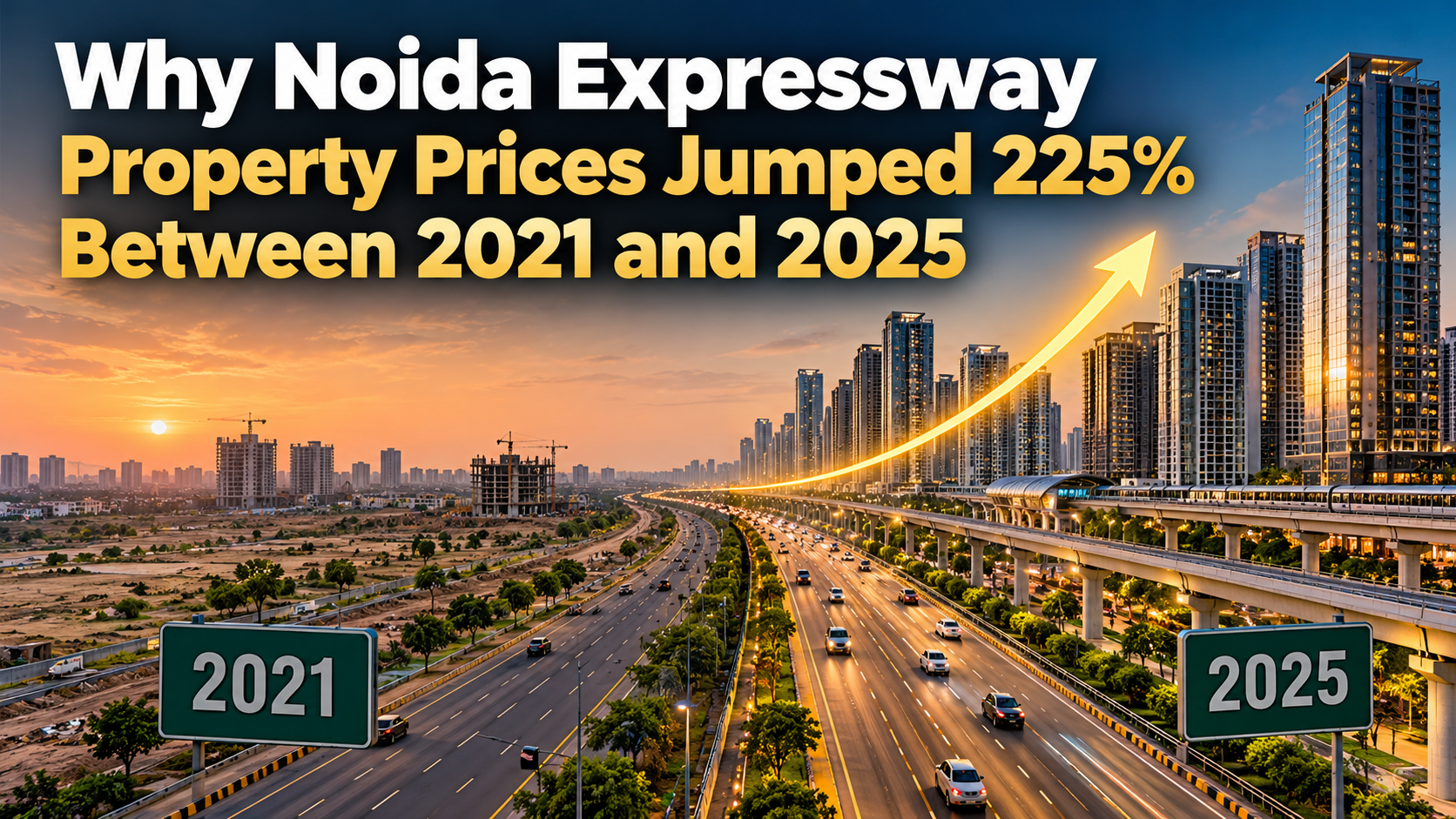
The real estate landscape of the National Capital Region has undergone a dramatic transformation over the last decade, but nowhere is this shift more visible than on the Noida-Greater Noida Expressway. Once considered a distant developing corridor catering primarily to mid-segment buyers, the expressway has rapidly evolved into one of the most premium and highly sought-after real estate destinations in Northern India.
For years, Gurugram held the undisputed crown for luxury living and high-value real estate in the NCR. However, the market dynamics have shifted aggressively. The Noida Expressway property price hike 2021-2025 is a testament to how meticulous urban planning, robust infrastructure, and changing buyer preferences can completely redefine a region’s valuation. What was once an affordable alternative has now become an exclusive address, leaving many early investors sitting on multi-crore portfolios while new buyers scramble to enter the market before prices climb even higher.
Decoding the Staggering Numbers Behind the Price Surge
To truly understand the scale of the real estate boom on the Noida-Greater Noida Expressway, one must look at the raw numbers defining the market trajectory. Between 2021 and 2025, the residential real estate market here did not just grow; it fundamentally re-rated itself.
Just four years ago, the average property rate along this high-speed corridor hovered around ₹6,600 per square foot. Fast forward to 2025, and that average base rate has skyrocketed to an astonishing ₹21,500 per square foot. This represents a staggering 225% appreciation in a remarkably short window.
When translated into tangible home prices, the difference is eye-opening. A standard 1,000-square-foot apartment that would have cost a buyer approximately ₹66 lakh in 2021 now commands a price tag of around ₹2.15 crore. A property buyer who hesitated four years ago is now looking at a price difference of nearly ₹1.49 crore for the exact same square footage.
It is also crucial to realize that these figures represent base prices. When you factor in preferential location charges, club memberships, car parking spaces, registry fees, and stamp duty, the final acquisition cost is significantly higher. The days of finding budget-friendly, sub-crore residential units on the main expressway corridor are effectively over, replaced by a market that caters to high-net-worth individuals, corporate executives, and affluent investors.
The Power of Infrastructure and Unmatched Connectivity
Real estate appreciation never happens in a vacuum; it follows the path of infrastructure. The primary catalyst for the skyrocketing property prices in Noida is the seamless, world-class connectivity the region now offers.
The expressway itself is an engineering marvel that allows residents to bypass the notorious city traffic. It serves as a high-speed arterial link connecting the national capital directly to Greater Noida and the Yamuna Expressway. But the road network is just one piece of the puzzle. The impending operationalization of the Noida International Airport at Jewar has cast a massive halo effect over the entire expressway corridor. Large-scale global infrastructure like an international aviation hub completely alters the commercial and residential viability of the surrounding radius.
Beyond the airport, the expansion of the metro network has been a game-changer. With the Aqua Line functioning as a dedicated spine for the expressway and upcoming direct interchanges planned at Botanical Garden for both the Blue and Magenta lines, dependency on private vehicles is dropping. This transit-oriented development means residents can live in expansive green sectors while maintaining a sub-30-minute commute to the major commercial hubs of Delhi and Noida.
The Corporate Boom and the Rise of Walk-to-Work Culture
You cannot build a sustainable residential real estate boom without a parallel explosion in job creation. The Noida-Greater Noida Expressway has successfully transitioned from a bedroom community into a powerhouse commercial spine.
Sectors ranging from 125 and 132 all the way to 142 and 153 have become magnets for multinational corporations, IT giants, startups, and massive coworking operators. These sectors are heavily populated with Grade-A commercial parks, Special Economic Zones, and high-street retail developments.
When leading global enterprises set up their regional headquarters along the expressway, they bring with them a massive workforce of highly paid professionals. This demographic does not want to endure grueling daily commutes from Delhi or older parts of Noida. They want premium housing just minutes away from their corner offices. This localized corporate boom has created a massive, captive audience for residential real estate, driving up both capital values and rental yields. The localized ecosystem of work, play, and living has solidified the expressway as a holistic destination rather than just a transit route.
A Structural Shift in Homebuyer Preferences
The definition of a desirable home has changed drastically since 2021. The pandemic permanently altered how families view their living spaces, and those behavioral changes are still dictating market trends in 2025.
Buyers are no longer willing to settle for basic, cramped apartments. There is a decisive movement toward larger floor plates. The 3 BHK and 4 BHK configurations have become the workhorses of the Noida Expressway real estate market. With hybrid work models becoming a permanent fixture in corporate India, having a dedicated home office is no longer a luxury; it is a fundamental requirement. Furthermore, multi-generational families pooling their resources are driving the demand for expansive duplexes and penthouses.
But it is not just about the size of the apartment; it is about the lifestyle outside the front door. Today’s buyers demand low-density living, vast expanses of green cover, and world-class amenities. They want resort-style clubhouses, Olympic-sized swimming pools, advanced security systems, and private concierge services. Developers have recognized this shift and have practically stopped launching affordable or mid-segment projects in prime expressway sectors. Instead, they are collaborating with international luxury brands and renowned architectural firms to build ultra-luxury bespoke residences. When every new launch in the vicinity is positioned as an ultra-luxury product, the baseline pricing of the entire corridor naturally elevates.
Shrinking Inventory and the Supply-Demand Imbalance
A critical factor driving the Noida Expressway property price hike is the simple economic principle of supply and demand. The real estate market in the Delhi-NCR region is currently experiencing a massive reduction in unsold housing stock, a metric known in the industry as “inventory overhang.”
Just a decade ago, developers were sitting on a massive pile of unsold units. At the previous absorption rates, it would have taken roughly 44 months to clear out the existing inventory in the NCR market. By 2025, that overhang has dramatically collapsed to just around 12 months.
This rapid clearance of stock has fundamentally shifted the bargaining power from the buyer to the developer. Furthermore, the volume of new project launches has deliberately been kept tight. While the early 2010s saw well over 1.5 lakh residential units being launched annually across the region, recent data shows that new launches have shrunk to a fraction of that number. Developers are focusing on executing high-value, premium projects rather than flooding the market with high-volume, low-margin buildings.
Coupled with the fact that prime land parcels along the expressway are rapidly depleting, land acquisition costs have shot through the roof. When developers pay a massive premium to acquire land, and pair that with rising costs for premium construction materials, those expenses are directly passed on to the end consumer.
Micro-Market Spotlight: The Standout Sectors
While the entire expressway has seen phenomenal growth, different sectors cater to different buyer profiles, each contributing uniquely to the overall property price appreciation.
The southern sectors, particularly Sector 150, have emerged as the poster children for luxury green living. Deliberately planned with extremely low ground coverage and massive open green areas, this sector is often marketed as the “Sports City” of Noida. Because the infrastructure, wide roads, and sewage grids were laid out long before the housing clusters arrived, it offers a thoroughly modern, congestion-free lifestyle that commands top-tier pricing.
On the other hand, micro-markets like Sector 137 have become undisputed champions for rental yields. Due to their immediate proximity to operational metro stations and major IT campuses, these sectors experience virtually zero vacancy rates. Investors looking for steady, monthly cash flows alongside capital appreciation have heavily concentrated their funds here, driving up the baseline property values.
Closer to the Delhi border, sectors like 94 and 128 are acting as the gateway for ultra-HNI (High Net-Worth Individual) investments. Benefiting from the immediate proximity to the DND Flyway and Kalindi Kunj, these sectors offer Delhi-like connectivity with Noida-style space. The introduction of global branded residences in this specific stretch has effectively bridged the prestige gap between South Delhi, Gurugram’s Golf Course Road, and Noida.
Is It Still a Good Time to Invest?
With property values having more than tripled in four years, the most common question among prospective buyers is whether the market has peaked. Has the train already left the station, or is there still room for growth?
For end-users—those looking to buy a house to live in—the decision should transcend pure financial returns. The Noida Expressway currently offers an unmatched quality of life, featuring a highly organized urban layout, proximity to top-tier international schools, super-specialty hospitals, and premium retail destinations. If the location aligns with your workplace, lifestyle requirements, and family needs, waiting for a hypothetical market correction might only result in being priced out of your preferred sector.
For pure investors, the landscape requires a more strategic approach. The days of buying any random project and expecting a 100% return in two years are largely behind us. The market has matured. However, long-term capital appreciation remains highly promising, largely because the area’s biggest catalyst—the Jewar Airport—is still in its evolutionary phase, and commercial occupancy along the expressway continues to densify.
Investors must now focus heavily on rental demand. Properties that cater to the massive influx of corporate professionals—such as well-managed 3 BHK apartments near metro stations or premium high-street commercial retail spaces—will continue to generate strong, sustainable returns. The key is to look at the institutional depth of the developer, the quality of post-handover facility management, and the specific hyper-local infrastructure nodes.
The Noida-Greater Noida Expressway has shed its reputation as a secondary alternative and boldly claimed its spot as a premier real estate destination. The 225% price hike from 2021 to 2025 is not an artificial bubble; it is the financial reflection of massive infrastructure execution, demographic shifts, and the region’s successful transition into a thriving, self-sustaining corporate and residential powerhouse. As land becomes scarcer and the area transitions fully from developing to developed, the exclusivity—and the valuations—of this corridor will only continue to rise.